Why Nobody Can Say What India Will Look Like in 2090, And Why Parts of It Are Being Decided This Year
2026-10-10
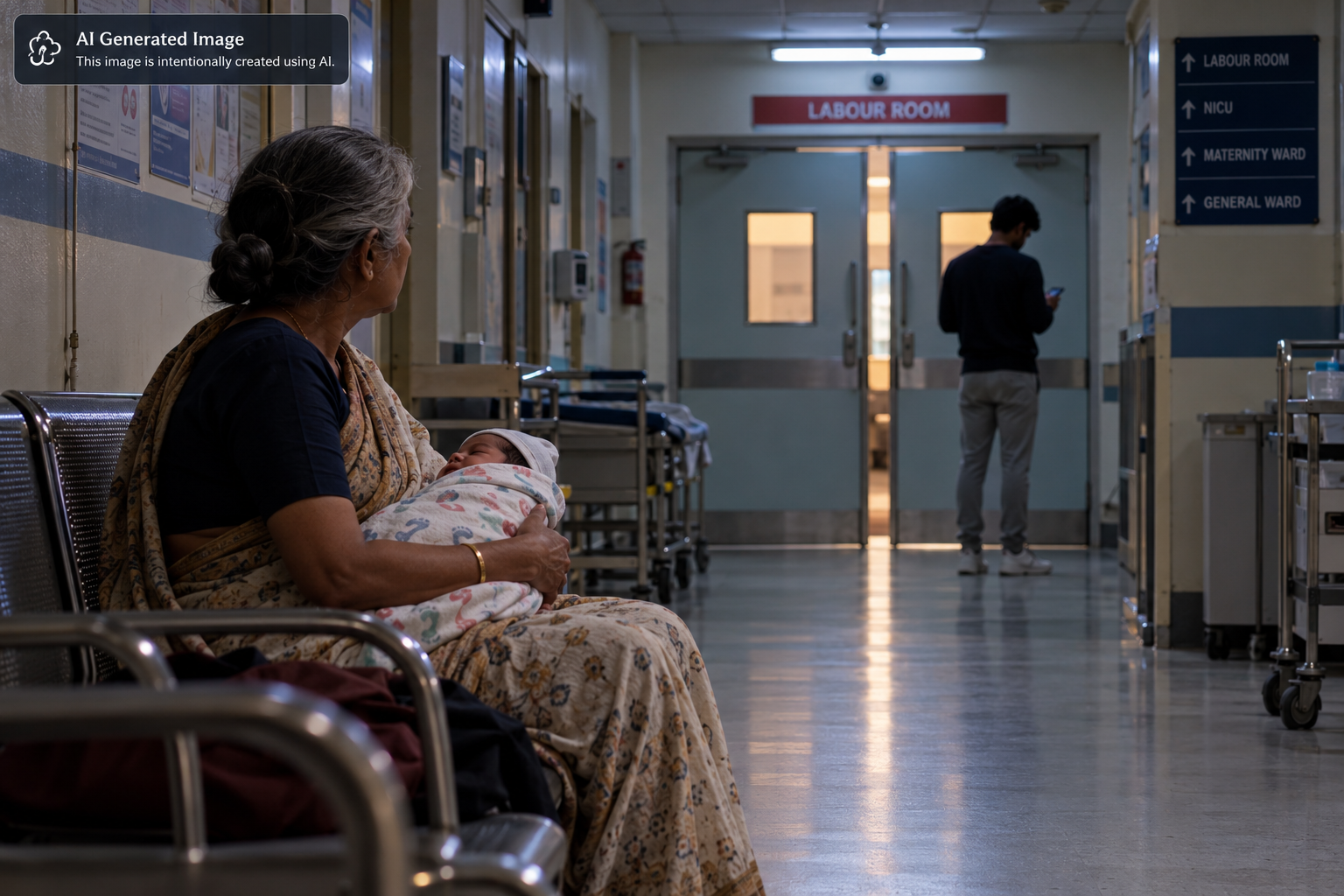
Picture a corridor in a district hospital somewhere in India, a little before dawn. A woman with grey in her hair sits upright on a steel bench with a newborn in the crook of her arm, and she is not quite asleep. At the far end, by the swing doors, a young man stands with his back to her, reading something on his phone. She was born in October 1962, which makes her sixty-four this month. The baby was born a few hours ago and will turn sixty-four in October 2090. I made all three of them up, but the arithmetic is real, and it is the part I keep coming back to. The same number sits on both of them, which means the woman has already lived the distance that a forecast of 2090 now has to cross.
Everyone has a picture of the country the baby will grow old in. An investment bank has published its estimate of the Indian economy in 2075. The United Nations has drawn India's population as a curve that runs to 2100. The government's own long-range goal carries a year in its name, Viksit Bharat 2047. Ask for a picture of 2090 and you will be handed several, delivered with more confidence than the distance deserves. What I wanted to know was how far any of them can be trusted, and the nearest thing to an experiment I could find was the woman on the bench. People were making forecasts about her country sixty-four years ago, too. We can see how they did.
She arrived in the month the war with China began, a war that ran from 20 October to 21 November 1962, and a forecast published five years later was bleaker still. In 1967 William and Paul Paddock published Famine 1975!, which proposed sorting hungry countries the way a field hospital sorts the wounded: those that would manage without help, those that could be saved with it, and those that could not be saved at all. India, along with Egypt, went into the last group, and the authors' advice was that food aid to such countries should stop. The reasons usually given for why that was wrong are a Green Revolution, a public distribution system and food-for-work schemes. I have read a summary of the book rather than the book, and I would not try to rank those causes. The country the Paddocks would have cut off is now the world's largest exporter of rice.
Two demographers did better. In 1958 Ansley Coale and Edgar Hoover published a book with Princeton University Press that took India's population of three hundred and eighty-four million in 1956 and asked what would happen if fertility stayed where it was. By the account in a review in the Milbank Quarterly, the answer was seven hundred and seventy-five million people by 1986. The United Nations' current estimate for India in 1986 is about seven hundred and ninety-one million. I would not make much of the near-match. Their starting figure was a little low, since the UN now puts 1956 at three hundred and ninety-seven million, and fertility did fall in those decades, so a count that finished near their high scenario means other things were moving too. Even so, as headcounts go, it was a better forecast than the Paddocks' account of what the heads would mean.
That is the pattern I want to hold on to for the rest of this piece, with a warning attached: it is one case, not a law. The arithmetic of people held up better than the story told about the people. The Paddocks and the demographers were looking at the same population. One side forecast a number and landed near it. The other forecast what the number would do to a society and was badly wrong, in a way that the country's later history made hard to miss.
Neither of those forecasts saw what the sixty-four years were made of. In September 2026 India's payment system handled about twenty-four billion transactions in a single month, a figure I take from an aggregator quoting the payments body's data. The IT-services industry now employs nearly sixty lakh people by its trade body's count. Neither thing existed in 1962, and between them they changed a good deal of how Indians earn and pay. I do not think that is an accident. Both were technologies, or markets built on them, and technology is among the fastest-moving things a society contains.
So the useful question about 2090 is not what it will look like. It is which parts of it can be known at all. My answer, which I will spend the rest of this trying to break, is that there are two: the people who are already born, and the rules that are already written. Almost everything else, including much of what the forecasts are about, is weather.
Start with the people, but first a word about a word in the question I was given. Designed assumes a designer, and population is one of the fields where states have tried hardest to design their own future. China did it with a rule and India tried it with a campaign. During the Emergency India ran a mass sterilisation drive. Coercion over targets is counted among the reasons Congress lost the election of 1977, when it fell to a hundred and fifty-four of five hundred and forty-two seats, and in June of that year the new government declared that family planning, renamed family welfare, would be wholly voluntary.
China's one-child policy began in 1980 and its official claim is that it averted four hundred million births. When the Brookings Institution looked at that claim around 2010, it found the number could not be substantiated. China's fertility had already fallen from five point eight children per woman in 1970 to two point seven in 1979, before the policy existed, and the policy may have hastened a decline that was already under way. The comparison cases point the same way. Brookings noted that South Korea's fertility fell from two point nine to one point two between 1979 and 2008 with no such rule, and that Thailand and Brazil roughly halved theirs too.
India's figure is now about two children per woman. The national family health survey, whose fact sheets came out on 29 May 2026, puts it at two, and the Sample Registration System's report for 2024, released around 22 May 2026, at one point nine. The Institute for Health Metrics and Evaluation puts it at about six point two in 1950. I cannot tell you how much of that fall belongs to policy, to schooling, to the cost of raising children, or to everything else that changed at the same time, and I am wary of anyone who can. What I can say is that the coercive phase of the policy was dropped in 1977 and fertility has since fallen to about two.
The national figure also hides a country that is already several countries. In the Sample Registration System's 2024 report, as the press carried it, Bihar is at two point nine and Delhi at one point two, while Kerala, Tamil Nadu and West Bengal are each at one point three. The family health survey puts urban India at one point six and rural India at two point one.
Where does the national figure settle? The UN's central projection, from its 2024 revision, has India's population peaking at about one point seven billion in the early 2060s, then falling to about one point six billion in 2090 and one point five in 2100. The Institute for Health Metrics, in a Lancet paper of March 2024, puts fertility at about one point three in 2050 and about one in 2100, which would cut annual births from about two point two crore in 2021 to about one point three crore by 2050. I did not find the fertility rate behind the UN's curve, so the two are not quite like for like. But they are two serious institutions looking at the same country, and where fertility settles is a good part of the argument about how many people India will have in the second half of the century.
South Korea is the cautionary tale and, oddly, the possible exception. Its fertility fell to about seven tenths of a child per woman in 2023, then rose to about three quarters in 2024 and four fifths in 2025, and in 2025 births rose six point eight percent and marriages eight point one percent. Two small rises prove little, but they tell me the floor people assume is not a law of nature, which is a reason to hold any projection of India's fertility loosely, in either direction.
So in the cases I looked at, I could not see a rule clearly doing the work, and nobody can say with confidence where India's number will settle. The number of old people is a different kind of thing.
Everyone who will be sixty-five or older in 2090 was born before the end of 2025. They are alive now or they are not, and the only thing left to forecast is how many of them will survive that long. On the UN's central projection India has about eleven crore people over sixty-five this year, which is seven point six percent of the population, and about forty-five crore in 2090, which is twenty-eight point three percent. Both headcounts are my arithmetic from the UN's shares and totals, so treat them as approximate. The count quadruples. The share is the less certain of the two numbers, because a share has a denominator, and the denominator is every child who has not yet been born.
A cleaner way to feel the change is to count the people who would be paying. In 2026 there are about nine people aged fifteen to sixty-four for every person over sixty-five. The UN's projection puts that at about four and a half in 2050 and two in 2090. Those ratios are my arithmetic too, and they carry the usual caveat that nobody says when work has to stop. There is a kinder detail, and I think it is the most important one in this part. Add up children and the old, and the number of dependants for every hundred people of working age is about forty-six today, about forty-eight in 2050 and about seventy-four in 2090. For the next quarter of a century the burden barely grows. It changes hands, from the young to the old. The unkind arithmetic arrives after that.
Who looks after the old now? The best national picture I found is the first wave of the Longitudinal Ageing Study in India, with fieldwork in 2017-18 among about thirty-two thousand people aged sixty and over. A little over a third of them were still working. Only about eight percent were receiving a retirement pension. About twenty-nine percent were receiving the government's old-age pension, which is open only to households below the poverty line. Roughly sixty-eight percent lived with their children, by my sum of the two categories that include them, and about six percent lived alone. The central government's contribution to that pension is two hundred rupees a month for those between sixty and seventy-nine and five hundred after eighty. States add anything from fifty rupees to thirty-eight hundred, about a thousand on average. When Parliament was asked on 5 August 2025 whether the central amount would be raised, the reply was that no such proposal was under consideration.
For most of the old, then, the pension in India is a household. That is not a complaint. It works, in the sense that most old people live with their children. But it runs on children, who are getting fewer, and on the unpaid hours of women. In the Time Use Survey of 2024, about eighty-two percent of women did unpaid domestic work on a given day against about twenty-seven percent of men, and those who did spent nearly five hours on it against under an hour and a half. The share of women over fifteen who were working or looking for work was forty percent in the 2025 labour force survey, which cautions that its new design makes comparison with earlier years loose. A pension that is really a woman's afternoon will be hard to hold if more women's afternoons are spoken for by paid work, and I do not see how to call that a problem without admitting it is the price of something many people want.
There is a harder part, and it comes from a different direction. According to the civil registration report for 2024, as a news summary gave it, nine hundred and seventeen girls were registered for every thousand boys, which is about a hundred and nine boys for every hundred girls. Where nobody interferes the usual figure is about a hundred and five. In a 2011 working paper the demographer Christophe Guilmoto projected that even if the ratio had returned to normal by 2020, about one Indian man in ten would still be unmarried at fifty in 2065. It did not return to normal by 2020, so his best case was somewhat better than what has happened, and that last step is my inference. A man who is fifty in 2065 was born around 2015 and is seventy-five in 2090. A large group of elderly men with no spouse and probably few children is exactly the group a household-as-pension cannot hold, and it arrives in the same decades as the quadrupling of the old.
If you want to see what a country looks like when it grows old before its pension system is ready, South Korea is the clearest case I know. In the OECD's Pensions at a Glance 2025, as the Korea Times reported on 11 July 2026, thirty-nine point seven percent of Koreans over sixty-five live in income poverty, against an OECD average of fourteen point eight percent, and that is the first time the Korean figure has dropped below forty. It was forty-nine point six percent in 2015. The article's explanation is about timing: the national pension matured slowly, so the first generation to grow old did so without much of one, and the poverty rate has fallen partly because the boomers now retiring draw on a mature pension and partly because an older and poorer cohort is dying off.
I would not push the comparison. India is not Korea, and I have no basis for predicting an Indian figure. But Korea shows that a pension which arrives a generation late does not simply arrive late. It leaves a generation in the gap.
The comparison that bothers me is with grain. In an earlier post, on why Indian families seem unconcerned about what they eat, I described the ration system as a water main: begun in the war years, hardened after the Bengal famine of 1943, and now free. Since 1 January 2024 it has meant five years of free grain for about eighty-one crore people, at a projected cost of about eleven point eight lakh crore rupees, on the Cabinet's decision of 29 November 2023. The state knows how to lay a main of that reach when the danger is hunger.
For old age, what it has laid so far is a voluntary pension scheme that people pay into, the Atal Pension Yojana, which had passed nine crore enrolments by 21 April 2026, according to the pension regulator. It promises a monthly pension of one thousand to five thousand rupees from sixty. That count is of total enrolments, so I cannot say how many accounts are active, and a pension promised from the age of sixty can only be tested when its subscribers reach it.
Who pays is the other half of the question. About seven and a half crore individuals filed income-tax returns for 2022-23, and sixty-three percent of them owed nothing, which leaves around two point eight crore people actually paying, a figure I derived from PRS Legislative Research's summary of the tax department's data rather than found stated. Filers were roughly six percent of the population by 2023-24. At the state level, the Economic Survey of 2026, as Down To Earth summarised it, estimated that states would spend about one point seven lakh crore rupees on unconditional cash transfers to women in 2025-26, and argued for conditional, time-bound transfers instead. I am not setting these against each other as a verdict. The point is simpler: the state's cash is currently being committed to people of working age, now, through channels that can be turned on in a single budget. A pension for forty-five crore people is a commitment of a different shape. It has to be made decades before the first claim.
Whether it can be made at all depends on one number that nobody can know, which is how rich India will be.
A much-cited attempt at that number is a research note that Goldman Sachs published in December 2022, which has India's economy as the second largest in the world by 2075, behind China's and ahead of America's. Goldman is an investment bank, which sells advice and manages money, and I mention that as a label rather than a charge. I know the note only as the press relayed it. According to those accounts it looks back at the bank's 2011 projections and finds that China, India and Indonesia came in slightly above them while Russia and Brazil came in below, and it names protectionism and climate as the biggest risks to its path. But look at what is being forecast. It is the size of the whole economy, and a country of more than a billion and a half people can have the second largest economy in the world while the people in it are still far from rich. A pension is paid to a person.
So where does a person start? The International Monetary Fund's April 2026 projections, as Scroll reported them, put India's income per head in 2026 at about two thousand eight hundred dollars, a little below Bangladesh's. That is a nominal figure at market exchange rates, so it moves with the rupee, and a figure adjusted for what money buys at home would look considerably better. I do not offer it as a verdict. It only marks the starting line.
From there the forecasts split, and one of the more sober comes from the World Bank. Its World Development Report 2024 counted a hundred and eight middle-income economies at the end of 2023 and found that since 1990 only thirty-four have moved up to high income. More than a third of those were helped by joining the European Union or by finding oil. Neither looks like an open road for India, though that is my reading and not the report's. The Bank puts the trap at about a tenth of America's income per person. An article in Scroll on 3 August 2024 relayed the report's extrapolation that, if the last fifty years' trend simply continued, India would need about seventy-five years to reach a quarter of America's income per head. Counted from 2024, that lands after 2090. It extrapolates a trend. It does not forecast events.
The distance between the optimist and the sceptic is smaller than it sounds, and that is what I find unsettling. Take two steady rates of growth in income per head, six percent a year and four. Either would be called a success. Over sixty-four years the first multiplies income about forty-two times and the second about twelve, which leaves the first country more than three times richer than the second. That is my arithmetic and an illustration, not a forecast of either rate. It does show how Goldman's note and the Bank's trap can both be reasonable. A difference that looks small in any single year compounds, over the distance between the woman on the bench and the child in her arm, into two different countries.
Is there a reason to expect the lower rate? The best-argued case I found for a lower ceiling is Dani Rodrik's. In an interview with VoxDev on 21 May 2026 he repeated an argument he has made for some years, that countries now reach their peak of factory employment at lower incomes than they used to, so late arrivals find less manufacturing work waiting for them. Services are the usual way round, and India's growth is led by them. But he points to work by Fan, Peters and Zilibotti finding that India's service growth is mostly in consumer services that are not traded across borders, such as retail, hospitality and transport, and not in software and outsourcing, which employ a small share. In the labour force survey for 2025, forty-three percent of Indian workers were still in agriculture and twelve percent in manufacturing.
Rodrik himself leaves a door open. In the same interview he suggests that AI may be different from earlier technologies, because it could extend skills to workers with less training. If that is right, a country with a very large number of less-trained workers is not only carrying a problem. That extension of his point is mine, not his. I cannot tell which way it falls, and I doubt anyone can yet.
The industry that was supposed to be the exception is a small test, and so far it reads both ways. NASSCOM, the trade body, reported that revenue for the year to March 2026 grew about six percent while employment grew a little over two percent, to nearly sixty lakh, and it flagged the gap itself. On 8 October 2026 TCS, one of the largest firms, said that annualised revenue from its AI work had reached about three billion dollars, over a tenth of the total, and by press count it added about four thousand people in the quarter. NITI Aayog, a government think tank, has a scenario study in which the tech workforce falls from between seven and a half and eight million in 2023 to about six million by 2031 on its baseline, and rises to about ten million if AI proves transformative. A scenario is not a forecast, and the other two are interested parties. If there is a signal, it is that the people closest to the business are writing down both outcomes.
All of that is about the economy. What about the people in it? Some of those who will be old in 2090 are in school at this moment. A child in the third standard in 2024 was about eight and will be about seventy-four. The Annual Status of Education Report for rural India found in 2024 that twenty-seven percent of third-standard children could read a text meant for the second standard. The figure was twenty-seven percent in 2018 too, and just over twenty in 2022, after the pandemic closures. By the fifth standard, forty-nine percent could. The same survey found that eighty-nine percent of fourteen-to-sixteen-year-olds had a smartphone at home. Those are different ages, so that is a pair of pictures and not a comparison. What the reading figures say is that a fall during the closures has been recovered, which is not the same as an improvement. Some of the people a pension in 2090 would be for are in those classrooms.
Who will have the money is a separate question. The World Inequality Lab's 2024 working paper by Bharti, Chancel, Piketty and Somanchi estimates that in 2022-23 the top one percent took about twenty-three percent of national income and held about forty percent of wealth, the highest shares in a series that starts in 1922. Its method leans on tax data and rich lists as well as national accounts and surveys, and critics note that India publishes no official data on the distribution of income.
The World Bank, working from the government's household consumption survey for 2022-23, found a consumption Gini of twenty-five point five, down from twenty-eight point eight in 2011-12, and extreme poverty at three dollars a day down from twenty-seven point one percent to five point three. These need not contradict each other. One measures what households spend and the other what the top earns and owns, and spending is usually less unequal than income, which is less unequal than wealth. A country can be getting less poor and more top-heavy at once, and I see no reason why the forecasts should expect one without the other.
Even the word that forecasts of a richer India lean on, middle class, has no fixed meaning. One Indian research body, PRICE, counts households with an income of five to thirty lakh rupees as middle class. Pew uses ten to twenty dollars a day, adjusted for local prices. A household can be inside one band and outside the other, and neither is wrong. A forecast of the middle class in 2090 is therefore a forecast of a definition as well as of a population.
Where will all those people live? The expected answer is that India will urbanise, as richer countries did, and move from the village to the city. I noticed that I could not say how far that move has already gone. By the current official definitions, thirty-one point two percent of the country is urban, a figure the research institute WRI India uses in an argument that the method needs rethinking. The World Bank's Agglomeration Index, built for the year 2010, puts fifty-five point three percent of Indians in areas with urban-like features. The years and the methods differ, so the two cannot simply be subtracted. But a gap that wide is hard to put down to noise, and it tells me that how urban India is depends on what you agree to call a town.
The deciding is done by rule. A place is a census town if it has at least five thousand people, more than four hundred to the square kilometre, and three quarters of its working men outside farming. Between 2001 and 2011 the number of such places rose from about thirteen hundred to nearly four thousand, and they supplied about thirty percent of the growth in the urban population, according to a working paper from the Centre for Policy Research. The same paper says they continue to be governed as rural settlements. Counting a place as urban and governing it as urban turn out to be separate acts, and for these places, on that paper's account, the first has happened without the second.
The United Nations' latest world urbanisation report, from late 2025, uses a new method that sorts the whole map into cities, towns and rural areas, and it finds that towns are the commonest kind of settlement in India. I could not find India's share under that method, so I cannot say whether it lands nearer thirty-one or fifty-five. My reading is that urban India in 2090 is not a figure waiting to be forecast. It is first a definition, then a decision about who governs which places, and only after those a headcount.
Wherever they live, they will live in heat. In 2017 Im, Pal and Eltahir published a study in Science Advances of wet-bulb temperature, the measure that combines heat with humidity and governs how well sweat can cool a body. If emissions follow a business-as-usual path, they found, parts of South Asia approach thirty-five degrees Celsius wet-bulb late in this century, and a few places exceed it. The most intense hazard falls on the densely populated farming regions of the Ganges and Indus basins.
That thirty-five came from theory. When a Penn State team tested twenty-four healthy adults aged eighteen to thirty-four, the critical wet-bulb temperature turned out to be about thirty to thirty-one degrees in warm, humid conditions and twenty-five to twenty-eight in hot, dry ones. Older people and people on medication would probably tolerate less. I take two things from that. The line that matters for a body sits lower than the number in the headline, and I did not find a study that redraws the map of South Asia with the lower thresholds, which I would not attempt myself.
The first study describes a world that depends on a choice nobody in India makes alone, because business as usual is a global path of emissions. India's own pledge, announced by its prime minister at Glasgow on 1 November 2021, is net zero by 2070. The child in the corridor will turn forty-four that year. Progress since the pledge is real and easy to misread, because two true numbers answer different questions. At the end of October 2025, just over half of India's installed power capacity was non-fossil. The think tank Ember reckons that clean sources supplied twenty-seven percent of the electricity actually generated in 2025, and fossil fuels seventy-three. Capacity is what could be produced, and solar produces only in daylight. Ember also records that coal generation fell by two point nine percent in 2025, in a year of low demand.
What can be designed is the response, and one city has a record. Ahmedabad's heatwave of 2010 caused, by one study's count, more than thirteen hundred excess deaths, though officials had counted about a dozen. In 2013 the city launched what is described as the first heat action plan in South Asia: colour-coded alerts five days ahead, a coordinated response by city agencies, public awareness, training, and cool roofs. An early research estimate, as a public-health case study summarised it, puts the deaths averted at about eleven hundred and ninety a year. That is an early estimate and not a trial, and I could not tell how it was constructed. But I like what it points to. If the estimate is anywhere near right, what changed was a routine, and not the weather or the economy.
The private version of the same response is the air conditioner. The International Energy Agency's figures, as BusinessWorld relayed them, are twenty-four air conditioners for every hundred Indian households, three times as many as in 2010, with ownership expected to rise ninefold by 2050. In the agency's stated-policies scenario, India's residential cooling alone would then use more electricity than the whole of Africa does today. The figure is per hundred households, so it does not say how many homes have one, and some have several. What it does say is that cooling is a purchase, and a household that can afford one is protected in a way its neighbour is not. My reading is that heat is also a measure of class. The agency separately estimates that each extra degree Celsius adds about seven gigawatts to India's peak demand.
Heat is the visible part of the weather. The water is harder to see. In a Rajya Sabha reply reported on 21 July 2026, the national stage of groundwater extraction, which is the share of the groundwater that can be taken each year that is actually being taken, was about sixty-one percent in 2025, down from about sixty-three in 2017. A falling average and an overdrawn handful of states are both true. Punjab is at a hundred and fifty-six percent, Rajasthan at a hundred and forty-seven and Haryana at a hundred and thirty-seven, and seven hundred and thirty of the country's roughly sixty-eight hundred assessment units, almost eleven percent, are classed as over-exploited.
Upstream, the 2023 Hindu Kush Himalaya assessment by ICIMOD, as Down To Earth reported it, warns that the region's glaciers can lose as much as eighty percent of their present volume by the end of the century. The rivers they feed first run higher and then run short, and more than a billion and a half people live downstream.
The air is the part that is not a forecast at all. The Air Quality Life Index at the University of Chicago, using 2023 data, puts India's average fine-particle level at forty-one micrograms per cubic metre, about eight times the World Health Organization's guideline of five, and estimates that meeting the guideline would add about three and a half years to the average Indian's life, and more than eight years in Delhi. This bears on the headcount of the old that I treated as nearly fixed. How many of the people now alive reach 2090 depends in part on what they breathe along the way.
So the stage is partly set elsewhere. How hot it gets depends on what the world burns, and no Indian policy decides that alone. What India does decide is the response, and the response, as far as I can see, is unequal in who receives it. Water adds a complication that heat does not. It crosses borders.
The Indus Waters Treaty has been in force since 1960, two years before the woman on the bench was born. In April 2025, after the attack at Pahalgam, India said it was holding the treaty in abeyance. On 31 August 2026 a Court of Arbitration administered by the Permanent Court of Arbitration held, unanimously, that abeyance does not suspend or terminate it. The court also barred India from concreting the dam wall and the power intake at the Ratle hydropower project above certain levels until ninety days after the neutral expert's final decision, which the court's press release says is expected in July 2027. India rejects the court as illegally constituted and says its suspension stands until Pakistan stops supporting cross-border terrorism. I have read the court's press release, not the award itself, and India's reply only through press accounts.
I am not equipped to judge the law, and I would be wary of anyone who says the question is simple. What interests me is the shape of it. A treaty is a rule that one side cannot rewrite alone. India declared it paused, a court has said a pause is not available, and India says the court has no standing. Those can all be true at once, and in the weeks since the award I found nothing to suggest the dispute is nearer to settled.
India is the upstream country on the Indus and the downstream country on the Brahmaputra. On the second river, China began building a hydropower complex at Medog on 19 July 2025, on the lower reaches of the Yarlung Tsangpo, which is what the Brahmaputra is called in Tibet. It is planned at sixty gigawatts, for more than a trillion yuan, with commercial operation due in 2033. China calls it run-of-river and safe. India's foreign ministry says it is monitoring and wants transparency and data sharing. Assam's chief minister has argued that the Brahmaputra is mainly rain-fed, which bears on how much an upstream dam could matter. China has not ratified the United Nations watercourses convention and, according to the summaries I read, has declined bilateral water-sharing agreements.
That is what separates the two rivers. On the Indus there is a treaty that one side says is paused and the other says is in force. On the Brahmaputra there is nothing to pause.
The least glamorous rule in this account is also, I think, the one that matters most. In 1976, during the Emergency, Parliament froze the number of Lok Sabha seats that each state holds, using the population count of 1971. About twenty-five years later it extended the freeze until the first census taken after 2026. The usual explanation, which I found in an explainer from the fact-checking site Factly and in PRS's note on the 2026 bills, is that the freeze was meant to reward states for stabilising their populations. Factly cites no debates, and I could not find them, so that is the common account and not one I have verified. Read that way, it was a promise made in the same years as the sterilisation drive I described earlier: do what is asked of you about family size, and it will not cost you representation.
Analysts at the Carnegie Endowment have put a number on what the promise has cost. They estimate that India's population has grown by nearly a billion since 1971. Bihar's has more than tripled and Kerala's has grown by about seventy percent. By their reckoning about eight percent of seats, some forty-four of the five hundred and forty-three, are allocated to the wrong state by the standard of equal weight for every voter. Uttar Pradesh and Bihar are each short by about two percent of the House, and Tamil Nadu is over by about as much. The average constituency holds about two point seven million people, against about seven hundred and eighty thousand in the United States.
On 16 April 2026 the government tried to unpick the freeze. It introduced a constitutional amendment, the 131st, and a Delimitation Bill. Between them they would have raised the ceiling on the Lok Sabha from five hundred and fifty seats to eight hundred and fifty, with up to eight hundred and fifteen for the states, allowed the seats to be redrawn on the latest published census, which is the one from 2011, and cut the one-third reservation for women in legislatures loose from its wait for a post-census redrawing. The hurry, as PRS explains it, is that a redrawing on the coming census is unlikely to be finished before the 2029 general election.
The next day, Friday 17 April, the Lok Sabha voted. With five hundred and twenty-eight members present, two-thirds meant three hundred and fifty-two votes. The amendment got two hundred and ninety-eight, against two hundred and thirty, and fell fifty-four short. The Wire reported it as the first constitutional amendment of this government to fail, and the Delimitation Bill was withdrawn.
Think of an irrigation canal with outlets cut into its bank, each sized in the year the canal was dug. The villages along it have grown and shrunk since. Nobody argues about the outlets while the water is plentiful and they are left alone. Re-cutting them is where the quarrel starts, because an outlet made wider for one village is felt as narrower by another. You can widen the canal itself so that every outlet grows, which is roughly what the expansion bill tried, but that needs the consent of nearly everyone on the bank. A seat in the Lok Sabha is an outlet of this kind. So is a share of the tax pool.
Take Tamil Nadu, which has thirty-nine seats. PRS's table, worked from the 2011 census, has it at thirty-two if the House stays the same size and seats follow population, and at forty-eight if the House grows by half and seats follow population. If the House grows by half and every state's seats grow by half, which is the version Amit Shah described to the Lok Sabha, Tamil Nadu has fifty-nine. Shah said that under that version the southern states' seats would rise from a hundred and twenty-nine to a hundred and ninety-five, leaving their share of the House at about twenty-three point eight percent, almost where it is now. But the assurance was spoken and not written into the bill, as the Carnegie analysts and The Wire both noted.
Opposition members said they supported women's reservation but objected to tying it to a redrawing that, on the bill's text, could use the 2011 count. Each side has a principle it can defend. The northern one is that a vote in Bihar should weigh about as much as a vote in Tamil Nadu, and on the Carnegie analysts' arithmetic it does not. The southern one is that states which did what the country asked of them on family size should not be paid in lost weight. Neither principle is wrong, and I cannot find a rule that fully satisfies both. The nearest thing in the Carnegie analysis is a House of about seven hundred and seventy-five seats, in which no state loses a seat.
Nothing has come back. Parliament's monsoon session ran from 20 July to 13 August and, according to PRS, did not take up the amendment. On 5 August the Parliamentary Affairs Minister said there was no proposal for a special session on 16 to 18 August, after press reports that one was planned. Both Houses were adjourned on 13 August and, by the latest report I found, dated 22 September, had still not been formally prorogued, which the Congress and a former Lok Sabha secretary general both call a record. The Congress reads it as a sign that the government is short of votes. That is its allegation, and no special session has been announced. Meanwhile the chief minister of Tamil Nadu has asked for a legislative assurance that no state's share will fall, and Karnataka's has asked for the present five hundred and forty-three seats to be held for twenty-five years.
The same year, 1971, is buried in a second set of outlets. The Sixteenth Finance Commission's award, which covers 2026-27 to 2030-31, shares forty-one percent of the divisible tax pool among the states by a formula. By PRS's summary the largest weight, forty-two and a half percent, goes to how far a state's income per head falls short of the average of the three richest large states. Seventeen and a half percent goes to population as counted in 2011. Ten percent goes to something the Commission calls demographic performance, which it measures as population growth between 1971 and 2011, with slower growth earning a larger share. So one term in the formula pays states for their headcount and another pays them for having slowed it, both worked out from the same census counts. That is the 1976 bargain written into a tax formula. The parallel is my reading, not the Commission's, but the base year is in both.
I had been about to write that rules like these last. Then I looked at what happened to the rural job guarantee. The Act of 2005 gave every rural household that asked for it a legal claim to work. On 16 December 2025 the government introduced a bill to replace it, the Viksit Bharat guarantee for rozgar and ajeevika mission, known as VB-G RAM G, and both Houses had passed it by the 18th, the Lok Sabha by voice vote amid protest. It promises a hundred and twenty-five days a year instead of a hundred, requires states to announce a pause of up to sixty days in the farming peak, shares the cost between the Centre and most states at sixty to forty, and has the Centre fix each state's allocation in advance, with the state paying for anything above it. It took over from the old law on 1 July 2026.
The Union rural development minister said the old law had shortcomings, among them that states spent more on labour than on materials. Critics, including a member of the governing alliance, pointed to the burden on states, and Mahua Moitra argued that because the Union government sets the budget, the bill guarantees little. A budget fixed in advance is easier to plan around. It is also a ceiling on a right. Which is the larger fact depends on how the allocations are set, and the first numbers do not settle it.
According to official figures as of 9 August, which Outlook and The Wire's summary of a report in The Hindu both relayed, the new law generated about half as many person-days of work in July, its first month, as the old one did in July 2025, and about half as many households got work. The ministry says it offered work to more than ninety-eight percent of the households that asked, and Outlook, citing the Indian Express, says the sowing-season pause might explain part of the fall, though no data show how much. A later Hindu count for August, which I know only from a summary, had person-days nine percent below the year before. The latest official total I found, from a factsheet reported on 29 September, is about thirty-two crore person-days for the first three months, with no monthly split to set against last year.
A fall in person-days can mean that fewer people asked or that fewer were given work. The ministry's figure points to the first, and I found no independent count of people who asked and were turned away, so I cannot say.
What I can say about the law itself is the speed. A law that had stood for twenty years was replaced by a bill that took three days to pass, in a Parliament where the government has a majority and, as April showed, not two-thirds.
The two rules differ less in importance than in how many people have to agree to change them. The freeze can be touched only by an amendment, which needs two-thirds, and in April the government could not find it. The job guarantee was an ordinary law. One has lasted fifty years so far and the other lasted twenty. Two cases prove nothing, and I would not build a theory on them, but they match the way the Constitution is built. What lasts is not what is written down. It is what takes many hands to unwrite.
The population count of the 2027 census asks Indians their caste for the first time since 1931. It was scheduled to begin in September 2026 in the snow-bound hills and is due to begin in February 2027 everywhere else. The question is number ten of forty, and it is open-ended. ThePrint reported on 14 August 2026 that enumerators will write down what people say, with no drop-down list and no tick-boxes. The Congress has written to the Prime Minister to say that this could split single communities into thousands of separate entries, and wants a list of caste names to choose from, as in the recent Telangana and Bihar surveys. A defender of the open form, a former chairman of Telangana's Backward Classes Commission, replies that a fixed list would miss communities known by different names in different regions, and that the sorting should come afterwards. The Centre says there will be a code directory and validation checks.
The argument is really about the step after the counting. The socio-economic and caste survey of 2011 ended with forty-six lakh distinct entries, according to the same report, and somebody has to decide which of them are the same community. Whoever maps the answers to groups is deciding how many castes India has, and those are the groups that quota lists, party strategies and court cases will use. I could not find a description of how the directory will do this. The nearest thing is a report, relayed by The Wire on 4 September from the Indian Express, that the Registrar General's office and the social justice ministry disagreed over whether existing caste lists could be used, of which I could read only the summary line. I say all this without suspicion. Any count needs a classification. It is only that the classification is where a count becomes a rule.
What a count can change depends on a rule older than the count. The cap of fifty percent on reservations is traced by one legal commentator, writing in Outlook in August 2024, to a Supreme Court judgment of 1962, and a nine-judge bench confirmed it on 16 November 1992 in the Indra Sawhney case. It has bent before. The quota for economically weaker sections takes the total past fifty percent, and the Supreme Court allowed it in 2022. Bihar tried again after its own caste survey found more than sixty-three percent of its people in backward and extremely backward classes. It raised its quotas to sixty-five percent, and the Patna High Court struck the law down on 20 June 2024, citing the ceiling, the use of population share as the basis, and the absence of a detailed study. The Supreme Court admitted Bihar's appeal on 29 July 2024 and declined to suspend the ruling. I could not find a final decision.
The same commentator supports a count but argues that the legal test is backwardness, not population share. If that is right, a complete count would not move the ceiling by itself. It would give the argument a number, and a court would still have to say what the number measures. That is my reading of the point, and it makes the ceiling a rule whose fate, in the end, a court decides.
Whether caste is counted is a different question from whether it persists, and the best evidence I know on persistence comes from a place no one would call a village. Banerjee, Duflo, Ghatak and Lafortune studied more than twenty-two thousand matrimonial advertisements placed in a Kolkata newspaper between October 2002 and March 2003, and followed up with some of the people who placed them. About seventy-two percent of grooms and sixty-eight percent of brides ended up marrying within their narrow caste. Their reading is that caste persists because it costs little: a same-caste partner of similar quality is usually available. I used the same study in an earlier post, on why India picks book smart at the gate, for a different finding, that families will accept a match with fewer years of education if it comes from within the caste. The sample is educated, urban, middle-class Bengalis from more than twenty years ago, and I could not find a recent equivalent.
Here is a connection I could not leave alone, and it is an inference. Earlier I gave the ratio of boys to girls at birth, about a hundred and nine to a hundred. If brides are scarcer than grooms, a same-caste partner of similar quality is harder to find, and the low cost that the study says keeps caste going may begin to rise. Caste might loosen at the margin, or families might pay more to keep it, or more men might not marry at all. I cannot tell which, and the study cannot say, because it describes a different market.
Another question about who Indians will be is really a question about numbers: whether religious communities are growing at different rates. The evidence I could find says the gap has been closing. Two researchers at the International Institute for Population Sciences wrote in The India Forum in July 2024 that the difference in fertility between Hindus and Muslims was about four tenths of a child per woman in the family health survey of 2019-21, down from a little over one in 1992. They put the fall in Hindu fertility at about thirty percent over twenty years and in Muslim fertility at about thirty-five, and they project that the two will converge, plausibly by 2030. That projection is theirs. I could not find religion-wise figures from the latest survey, and numbers rarely settle a question this charged, so I would hold this loosely.
In at least one state, language is being fought through money. In March 2026 the Minister of State for Education told the Lok Sabha that the National Education Policy imposes no language on anyone, and that it asks states to build the capacity to teach three languages, with children reaching proficiency in at least two Indian languages by fifteen. Tamil Nadu says the Centre is withholding school funds over the policy and the PM-SHRI schools scheme. The Centre says it has released five hundred and thirty-eight crore rupees, that more depends on utilisation certificates, and that Tamil Nadu's memorandum of understanding under the scheme is unsigned. The report I read does not say what amount Tamil Nadu says is being held back.
I set out to read about who Indians are and kept finding procedures: an open question with no tick-boxes, a judgment of 1992, a memorandum that one side calls unsigned. There is one kind of procedure India has built quickly, and it is worth asking why.
The kind is the rail. In September 2026 the Unified Payments Interface carried about twenty-four billion transactions, up about twenty-three percent on a year earlier, according to an aggregator quoting the payments body's data. It is tempting to read that as proof that India can build fast, and it is. But it is not unique to India. Brazil's central bank launched Pix in November 2020, and by March 2024, according to an interview with the European Payments Council, it had about a hundred and fifty million users, roughly three quarters of the population, and had handled forty-two billion transactions in 2023. A payment rail run by a central bank reached most of a large country in a little over three years. Brazil did it with a different institution and a different name, which makes me think the speed belongs to the kind of thing a rail is.
I think the reason is that a rail is additive. A new payment system need not take anything from anyone who already has an outlet on the canal. Banks, apps and customers can join without anyone losing a seat or a share. The freeze and the Finance Commission's formula are the opposite, because whatever one state gains another loses. That would explain how India can build a payments system in a few years and cannot reallocate its seats between states in fifty. It would not mean Indians are good at one kind of design and bad at the other. It would mean that one kind need cost nobody anything. That is my reading, and it is a reading rather than a finding.
But a rail stops being neutral once an entitlement rides on it. Libtech India, a consortium of academics and activists, reported in 2025 that roughly a quarter of the workers on the rolls of the old rural job guarantee were ineligible for payment through the Aadhaar-based system as of 7 April 2025, though only about one and a half percent of those then active. The report's own percentage and head count differ a little, so I give the rounded figure. The government replied, as reported, that the system ensures timely wages and deals with the problem of workers changing bank accounts, and that ineligibility would not cost anyone work. Libtech disputes that, with cases from the field. I cannot adjudicate between them.
The new law pays wages by direct transfer, keeps e-KYC-verified job cards valid and uses face authentication for attendance. The ministry's own summary says that workers are not to be denied employment merely because e-KYC is pending. The safeguard is written down. Two months after the launch, The Wire reported, summarising a report in The Hindu, about ninety-five percent of workers active in the past three years had completed e-KYC, which left about fifty-seven lakh who had not. The Wire's account also describes e-KYC as a condition for getting work, with exceptions for some unverified cards, and I could not tell from either document how that sits beside the ministry's safeguard. Two days later The Wire headlined a government reply that it would not insist on e-KYC for workers left behind, and I could read only that headline and its summary line. Whether the safeguard holds is something the rail itself will show.
I should say what I may be missing. I am describing the rails that worked, and I did not go looking for the ones that did not. If there are many of those, the picture of a country that builds rails quickly is a picture of survivors.
I came to this wanting to know what 2090 would look like, and I have ended with two piles and a split. One pile holds what is already in the building: the people who are already born, and the rules that are already written. The other holds everything the forecasts are about, such as how fast incomes grow, what factories and screens do to work, how hot the world gets and which technology arrives. I cannot see into the second pile, and I found nobody who can. The split is inside the first. Not every written rule stays there for long.
That is where the job guarantee changed my mind. I had assumed that a rule, once written, was a fact about the future in the way a birth is. A treaty of 1960, a ceiling of 1962, a freeze of 1976 and a ration system older than the Republic all seemed to say so. But a bill to replace an Act of 2005 went through Parliament in three days, and I do not think the difference was that the Act mattered less. It needed fewer people to agree. What lasts is what takes many hands to unwrite, a counterpart across a border, a bench of nine judges, two-thirds of a House. The fights this year are over the outlets in that canal, which is why they look so dull from outside.
Here is the objection I cannot dismiss. Sixty-four years is one case. The treaty dates from 1960 and the freeze from 1976, and both are still being fought over rather than abandoned, but that does not show they would survive a shock larger than anything in those years, and a back-cast across one stretch of time says little about the next. Already born also fixes a headcount, not a life. The old of 2090 may work longer than anyone assumes, or live somewhere nobody has predicted, or be looked after in ways I have not imagined. I think the difference between the knowable and the unknowable is real. I may have drawn the line in the wrong place.
So here is what would change my mind. If the seats are reallocated by agreement after the 2027 count, with the south's share protected in writing and not by a promise in the House, then formulas bend more easily than I think. If the state lays a pension main for the old at something like the scale of the grain main, and it survives a change of government, the arithmetic of the old is less frightening than it looks. And if the ceiling on quotas goes the way of the job guarantee, then many hands is not the right measure of what lasts. None of those has happened yet.
Go back to the corridor. The payments system that probably runs through the phone in the young man's hand did not exist when the woman was born, and nobody I read forecast it. What was already there when she arrived was a treaty two years old, a ceiling on quotas that one commentator dates to that very year, a ration system older than the Republic and, when she was in her teens, the freeze. She has lived inside them, the last of them for fifty years, and they are still being argued about. The child in her arm will be handed a different list, and parts of it are being written this year: in a Parliament that could not find two-thirds, in a census question with no tick-boxes, in a court whose authority one party rejects, in a tax formula that runs to 2031. Most of the people writing it will be gone by 2090.
The young man at the swing doors has not turned round. The woman is still watching the doors, and the child is asleep. I made the three of them up, but the arithmetic is real, and so is the list. If there is a way to design a country, the nearest thing I can find is to decide, in a year nobody will remember, what the child will find already there.
Notes: Population, age-structure and dependency figures come from the UN's 2024 revision (medium variant) as published in aggregator tables, and I could not confirm that no newer revision exists. The headcounts of the old, the dependency ratios, the 2090 age of the unmarried-men cohort and the compounding illustration are my own sums from them. The IHME fertility path, the family health survey and Sample Registration System figures and the civil-registration sex ratio rest on press summaries, the last through an exam-preparation site. The Paddock, Coale-Hoover and one-child-policy material comes through a Wikipedia entry, a journal review and a Brookings paper, not the originals. Forecasts and scenarios are labelled as such: the UN, IHME, Goldman Sachs (known here only through press accounts), the World Bank's extrapolation, a NITI Aayog scenario, the International Energy Agency's stated-policies case, Guilmoto's projection and the IIPS authors' convergence projection. NASSCOM, TCS and Libtech are interested parties, and Libtech's own figures disagree slightly, so I round. The ageing study, time-use and labour force surveys, ASER, the Lok Sabha pension reply and TCS's results release are primary documents. The Korean pension comparison rests on one Korea Times article, the Atal Pension Yojana count on a trade-press relay, the Economic Survey and income-tax data on summaries, the World Inequality Lab paper on its abstract page, and the middle-class definitions on a secondary summary. Heat, groundwater, glacier and cooling figures come through abstracts, press reports and summaries, and the Ahmedabad estimate is early research, not a trial. I read the Indus court's press release, not its award, and India's reply comes through the press; the Medog and census-schedule details lean on Wikipedia. The reason for the 1976 freeze comes from an explainer and PRS, not the debates, and the seat, vote and Finance Commission figures from Carnegie, PRS and The Wire. The job-guarantee and e-KYC figures are press relays of official data, the August count known only from a summary of The Hindu, and the government's e-KYC reply and the caste-list dispute only as headlines or summary lines. UPI figures come from aggregators and Pix from one interview. My own inferences, marked where they occur, are the bride-scarcity link to caste, the parallel between the freeze and the Finance Commission's formula, the canal analogy, the reading of rails as additive, and the claim that what lasts takes many hands to change, which rests on two cases and one back-cast. The delimitation, Indus, census and job-guarantee items were rechecked on 10 October 2026 and are still moving. All figures are as of October 2026 and indicate a pattern rather than precise national constants.