Why India Picks Book Smart at the Gate, And Street Smart for Everything After
2026-10-07
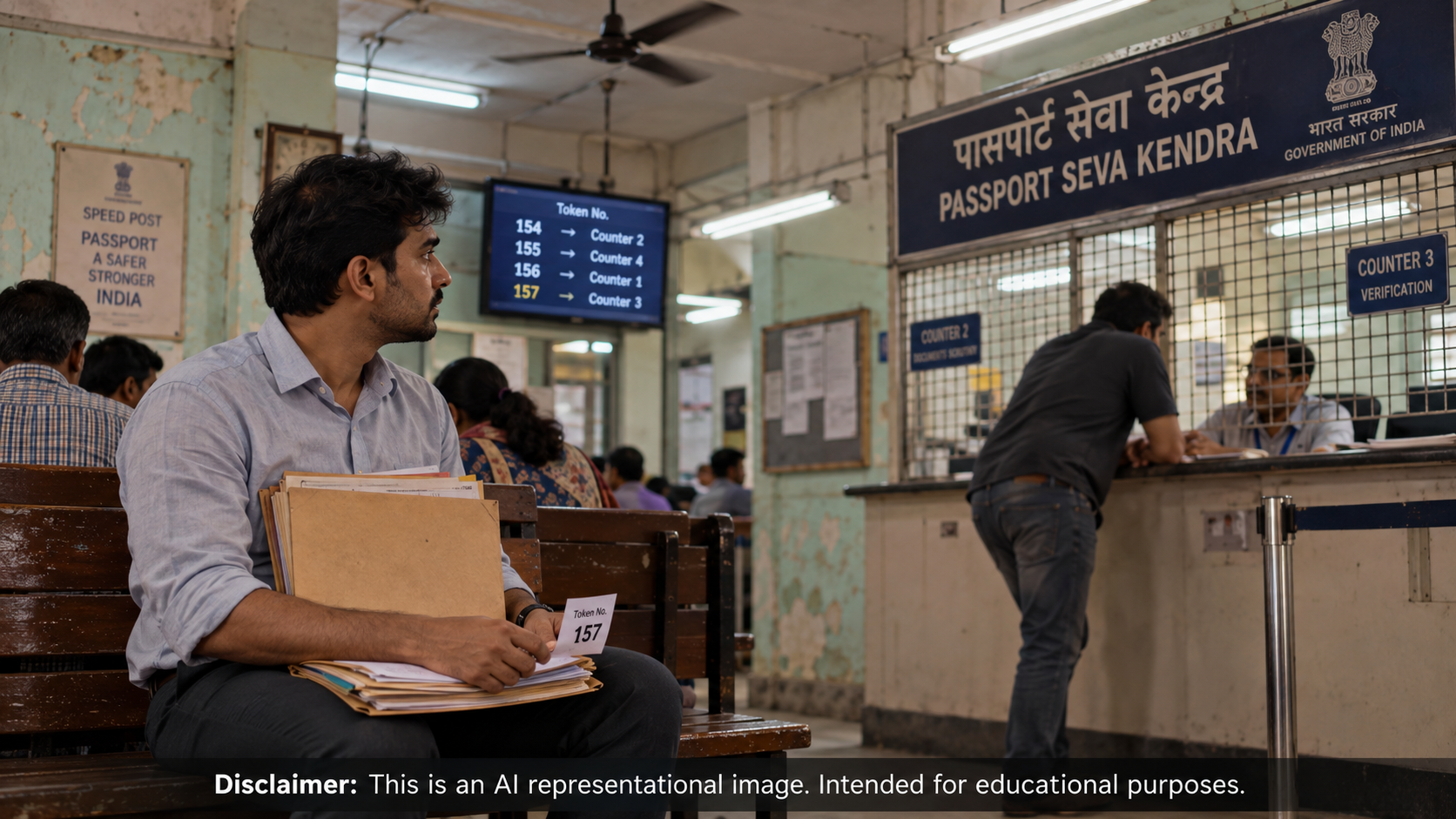
I spent four hours at a passport office with a file I had checked three times the night before, every form signed in the right ink, every photocopy attested, every annexure in the order the website said to put it in. Two counters down, a man about my own age walked in with nothing in his hands, said something to the clerk I couldn't hear, and was gone before my token number had even been called. I don't know what he said. I don't know who he knew. I only know he left before lunch, and I was still sitting there when the counter shut for it.
For a while I told myself the easy story: he had an edge, a shortcut, maybe something I wouldn't have been proud of using myself. But the longer I sat with it, the less it looked like a shortcut and the more it looked like a completely different skill, one that has nothing to do with how carefully you can fill in a form, and everything to do with knowing which actual human being in that building has the power to decide something. I had prepared for a test. He had prepared for a negotiation. Neither of us had read the room wrong. We had each simply prepared for a different building than the one actually standing in front of us.
That is roughly where this question always lands in India, book smart or street smart, which one actually gets you further, and chasing it properly means admitting the honest answer isn't "book smart," isn't "street smart," and isn't even the comfortable compromise of "you need both." It's that the country keeps switching, without any warning, which question it is actually asking you. Almost nobody is told the switch has happened until they're already standing in the wrong line.
Start with the one place in India where this switch never happens, where the rules are published, fixed, and apply identically to everyone: the Union Public Service Commission's Civil Services Examination, the only route into the IAS. Not "the most common route." The only one, the one real technical exception, a lateral-entry scheme that brings in outside specialists, doesn't even carry the IAS designation itself. Every year, something over seven lakh people sit the exam for a shot at it, and fewer than one in five hundred get through. Nobody you know in that building can quietly wave you past the cutoff. There is no counter to lean into. The only lever that moves anything is the exam itself, and the exam is, by design, impossible to street-smart your way through: no clerk to befriend, no file to skip, no queue to jump.
It would be tempting to call this a story about government versus everything else, except that the very building I sat in for four hours is also run by the government, and the government there behaved nothing like the UPSC at all. The difference isn't who's in charge. It's what kind of problem the institution is actually solving. UPSC has to rank several lakh total strangers against each other, at scale, in a way that has to survive a courtroom challenge from anyone who loses. A single, legible, defensible number is the only tool built for that job, so the number is all that counts. A passport counter isn't ranking anyone against anyone else. It's processing one file at a time, with enormous discretion sitting in the hands of whoever happens to be at that window that day, and discretion with no scoreboard attached to it is exactly the condition under which knowing a person starts to outperform knowing a procedure.
Hiring in India runs on the same fault line, just less visibly. A World Bank survey of small Indian enterprises found referral-based hiring ranging from four in ten up to as high as two in three, depending on the sector, and separate labour-market research in Kolkata found the same basic pattern holding even under controlled, lab-style conditions. None of that is a comment on how smart book-smart people are. It's that most Indian hiring, outside the small sliver that runs through a formal exam or a campus-placement funnel, isn't actually a ranking exercise at all. It's one employer deciding whether to trust one specific person, and a referral is simply a faster, cheaper way to answer that than reading a transcript.
Business ownership makes the split even sharper, because it hands you a genuine before-and-after. Dhirubhai Ambani left formal schooling after the tenth standard and spent his early working years as a petrol-pump attendant and clerk in Aden, watching dhows and cargo ships settle their accounts in half a dozen currencies, which is where, by every account of his life, he actually learned the arbitrage instincts that eventually built Reliance into India's largest private company. For most of that climb, nobody was evaluating him against a pool of equally credentialed strangers. He was simply trying to be right about the next trade. There was no admissions committee for what he was doing, so there was nothing for a degree to signal to.
Compare that to how a startup actually gets funded today. Venture investors routinely have to decide, in a matter of weeks, whether to hand a stranger a large sum of money, with almost no way to verify what that stranger can actually do. One tally of India's unicorn founders found more than a hundred coming out of a small cluster of IITs and IIMs alone, IIT Delhi by itself accounts for more than thirty, and a separate look at a batch of Series A deals found three out of five founders were IIT or IIM graduates. A pedigree, in that specific room, is doing exactly the job an exam score does for the UPSC: compressing a stranger you cannot fully verify into one fast, legible proxy. It's worth holding onto the other half of that same data, though, because it cuts the other way too, roughly four in every ten of those same unicorn founders came in with no pedigree of that kind at all, which means the filter is real and heavily weighted, but it is not, in the end, a hard gate the way UPSC is. There's a telling coda to the Ambani story here too: the generation that built Reliance on zero formal credentials is now the generation whose granddaughter holds a psychology degree from Yale. That isn't hypocrisy so much as the same mechanism reappearing right on schedule, once a family moves from quietly out-trading a local market to being evaluated by the entire world's capital and high society at once, it runs straight back into rooms full of strangers who need a fast way to trust it.
Zoom out past India and the passport-counter half of this story stops looking like a peculiarly Indian failing at all. China has a word for exactly this kind of relationship-based navigation, guanxi. The Arab world has wasta, one study of hiring there put the share of jobs secured through it above half. Russia and the post-Soviet states have blat. South Korea has yongo. Different continents, different languages, different religions, same underlying shape: wherever formal institutions carry a lot of unchecked discretion and not much consistency, an informal, relationship-based system grows up right alongside the formal one to compensate for it. India's own numbers fit squarely inside that pattern rather than standing apart from it, the country currently sits 91st of 180 nations on Transparency International's corruption index, a score that has barely moved in a decade, with a glut of overlapping rules and permissions behind it that hands enormous personal discretion to whoever happens to be holding the stamp that day. Street smart, in other words, isn't a peculiarly Indian cultural trait. It's the universal, entirely rational response to a system with real power and no reliable scoreboard, and India simply has an unusually large number of such systems stacked back to back in daily life.
The marriage market belongs in this same family of problems, and it produces the strangest, most precisely measured version of it. A 2009 study built on Bengali matrimonial advertisements, Abhijit Banerjee, Esther Duflo, Maitreesh Ghatak and Jeanne Lafortune going through the full record of ads placed, responses received, and matches eventually made, found that Indian families are willing to accept a prospective match with meaningfully fewer years of education, provided that match comes from within their own caste. That finding only makes sense once you notice what a matrimonial ad is actually trying to do: present a near-total stranger to an audience of other near-total strangers, who will typically meet the family a handful of times before committing a child's entire life to the decision. There's no way to actually watch this person operate under pressure first. A degree, a rank, a listed qualification, these become the one portable, comparable, legible fact two families who have never met can actually negotiate over, in the same way a VC negotiates over an IIT tag, and in the same way UPSC negotiates over a percentile. Street smart has never had an equivalent line to put in that ad. There's no column for "knows how to get things done," because there's no shared unit two strangers can compare it on.
Which is what makes it worth going back more than two thousand years, to the one figure in Indian intellectual history who seems to have refused the entire premise of this split. Chanakya, also called Kautilya, a Brahmin scholar traditionally credited with the Arthashastra, the most thorough treatise on statecraft the ancient world produced, was, by every surviving account, also the kind of operator who spent years testing a teenage Chandragupta's character before ever revealing his own plan, engineering the fall of an empire through patience and misdirection rather than open confrontation. Later tradition folded a second, more aphoristic text, the Chanakya Niti, under his name as well, a collection less concerned with how a state should be structured and more with how an individual actually reads a room, a rival, a moment. Historians argue, reasonably, about how much of either text one single person wrote, and about dates that are hard to pin down to the century, let alone the decade. But the figure that tradition settled on wasn't half of a pair. He was the scholar and the operator at once, because in his world there was no separate waiting room for the stranger-evaluating-you version of the problem and the nobody's-watching-figure-it-out-yourself version. It was one continuous, high-stakes relationship with one king, and both skills were simply what competence looked like inside it.
Which finally answers the question I actually started with, sitting in that passport office. "You need both" isn't the empty, conflict-avoiding answer it sounds like when someone reaches for it to end an argument. It's a reasonably precise description of a single ordinary week in India, which can ask you to clear an exam with a fixed, impersonal cutoff on a Monday, and then ask you, with no exam in sight, to find the one person in a building of two hundred who can actually move your file on a Wednesday. Book smart decides which room you're let into. Street smart decides what happens to you once you're standing inside it. Almost nobody's life only ever requires one of the two, which is probably the real reason the combination answer keeps surviving every attempt to argue it away, not because it's a clever synthesis, but because it's just an accurate weather report for the country it's describing.
I still don't know what the man at the other counter said that day, or who he knew, or what he'd had to learn to get that good at saying it. I know I'd spent years building the other skill, the one that got me a seat in that waiting room in the first place, filed correctly, in the right order, ready for a test nobody at that particular counter was actually administering. Neither of us had wasted our years. We had just each spent them preparing for a different ten minutes of the same building, and the only real uncertainty left, walking out past him with my folder still mostly unopened, was which of the two he'd be asked for the next time he walked in.
Notes: Figures on referral-based hiring in India are drawn from multiple labour-economics studies, including a World Bank enterprise survey and lab-and-field research in Kolkata; exact shares vary by sector, region, and study design and should be read as indicative rather than a single settled number. UPSC Civil Services Examination figures (aspirant numbers and selection rate) are drawn from UPSC-focused reporting and vary slightly year to year. IIT/IIM pedigree figures among funded startups and unicorn founders are drawn from industry analysis by YourStory, Quartz, and independent venture-capital writeups, based on data from Tracxn and LinkedIn; these are observational counts, not randomized studies, and "pedigree" is defined slightly differently across sources. Biographical details on Dhirubhai Ambani's early life and career, and on his family's later educational choices, are drawn from multiple published profiles. India's corruption ranking is from Transparency International's 2025 Corruption Perceptions Index. Material on guanxi, wasta, and blat is drawn from comparative academic literature on informal networks in China, the Arab world, and Russia/the post-Soviet states respectively; the wasta hiring figure comes from a single cited study and should be read as illustrative of the phenomenon rather than a precise regional constant. The marriage-market findings are drawn from Banerjee, Duflo, Ghatak and Lafortune's 2009 study of matrimonial advertisements in a Bengali newspaper. Chanakya's exact dates, and the authorship and composition date of the Arthashastra, are genuinely disputed among historians, with serious scholarship dating parts of the text anywhere from the third century BCE to the early centuries CE; the account above follows the traditional narrative, which remains the most widely told version even where parts of it cannot be independently verified.