Why Indian Families Seem Unconcerned About What They Eat, And Why the Cure for Hunger Became the Diet
2026-10-09
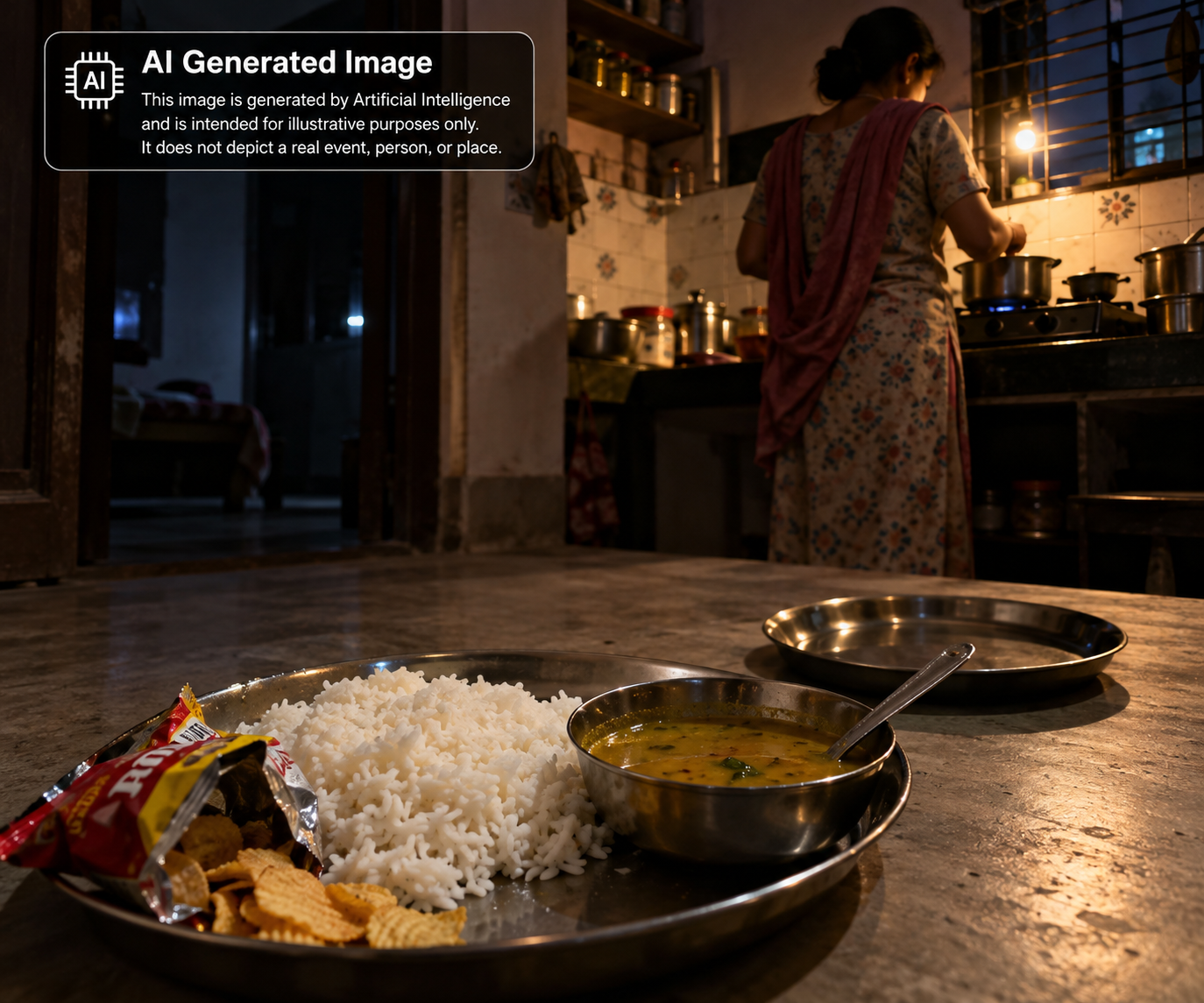
Picture an ordinary weeknight in an ordinary kitchen somewhere in India, around nine. A steel thali sits on the floor with a hill of rice in the middle of it, a ladle of dal thin enough to see the steel through, a spoonful of potato, a wedge of pickle. A packet of something fried lies torn open beside it. The children are eating. The woman who cooked all of this will sit down once the others have finished and the pots are done. Ask her whether her family eats well and she will say yes, and mean it, and by the oldest measure there is she will be right. Nobody in that kitchen is hungry. Nobody in it is careless about food, either. The whole evening has been organised around it. So why do we say, so easily, that people in kitchens like hers do not care what is on the plate?
The question as it is usually put has a problem in its premise. Food is where an Indian household puts a large part of its money, roughly forty-seven percent of monthly spending in rural homes and forty percent in urban ones, in the government's 2023-24 consumption survey. In the National Sample Survey of 2009-10, about ninety-nine percent of rural households and almost every urban one said they got two square meals a day throughout the year. The Taittiriya Upanishad, in Max Müller's nineteenth-century translation, lists a set of rules about food, and one of them reads, "Let him acquire much food, that is the rule." Another says never to turn a stranger away from the house. I would not claim that a text that old sets anyone's dinner. What I notice is what it asks for, which is plenty, reverence and hospitality. None of those rules asks what the food contains.
Behaviour points the same way. In Poor Economics, Abhijit Banerjee and Esther Duflo describe very poor households that, given a little extra money, spend it on tastier food rather than on more calories or better nutrition. The biggest single food line in India's 2023-24 household budget is not cereals or milk. It is a category called beverages, refreshments and processed food, about ten percent of total rural spending and eleven percent of urban, which the survey's press note does not define, so I would not read it as packaged junk alone. Indian households are concerned about food. They are concerned about enough, about plenty, about taste and about the guest. The better question is what that kind of concern leaves out, and to find out you first have to ask how well it has done its own job.
On its own terms, it has done well. The UN's estimate of the share of Indians who are undernourished fell from about twenty-one percent in 2004-06 to under ten percent in 2023-25, according to its July 2026 report. The household surveys put average intake at a little over two thousand two hundred calories a day per person, and that of the poorest twentieth at about seventeen hundred. Those figures are worked out from what families buy, not from what anyone is seen to eat, and the economists Angus Deaton and Jean Drèze documented in 2009 that India's average calorie intake had fallen even as incomes rose, which they thought most likely reflected lower energy needs rather than scarcity. Under ten percent is still about fourteen crore people, so this is not a solved problem. But it is now the tail of the distribution more than the body of it.
For most households, then, the plate is full. That only moves the question to what it is full of.
Start with protein, since it is the one nutrient everybody has an opinion about. A much-repeated figure comes from a 2017 survey that Danone's Indian arm ran with the research firm IMRB, covering about eighteen hundred mostly urban respondents. It reported that seventy-three percent had poor protein intake and ninety-three percent did not know how much they needed. That may be right. I could not find the cut-off it used, and the company behind it sells protein products, so it has an interest in the answer. The official yardstick is more awkward. The ICMR-NIN, the national nutrition institute, sets the recommended intake in its 2020 requirement tables at roughly four-fifths of a gram per kilo of body weight, which works out to about fifty-four grams a day for a reference man and forty-six for a reference woman. The government's 2023-24 survey puts the average Indian at about sixty-two grams in rural homes and sixty-three in urban ones. On paper, the average person clears the bar.
The same tables carry a footnote, though: people living on a cereal-based diet with low-quality protein need nearer a full gram per kilo. And that is where the shortage seems to sit. The protein is there, but a large share of it travels on cereals, which supply about forty-six percent of it in rural homes and thirty-nine in urban ones, against under ten percent from pulses. The plate is changing, slowly. Since 2009-10 the cereal share of protein has fallen by about fourteen points in rural India and thirteen in urban, yet average protein has only crept from about fifty-nine grams to between sixty-two and sixty-three.
That makes a scoop of whey look like an answer to somebody else's question. Press reports of the ICMR-NIN's 2024 dietary guidelines say they advise against protein supplements for building muscle, and I am in no position to say who might need one. But a powder seems a poor answer to what, to my eye, is a shortage of dal, milk and eggs beside the rice. That is my reading of the numbers, not something any of these sources says in so many words.
The nutrients nobody counts are harder, because here even the measuring is in dispute. In the National Family Health Survey of 2019-21, sixty-seven percent of children between six months and five years and fifty-seven percent of women aged fifteen to forty-nine were anaemic. But anaemia is a haemoglobin reading, not a diagnosis of what the plate lacks, and the survey took its blood from a finger prick. Anura Kurpad and Harshpal Sachdev argued in Indian Pediatrics in 2022 that this overstates the problem. A study of about a thousand women in Uttar Pradesh found anaemia in fifty-nine percent by finger prick and thirty-five percent by vein, and the 2016-18 national nutrition survey of children and adolescents, which drew venous blood, found about thirty-one percent, a third of it from iron deficiency. The age groups differ, so that is a pointer rather than a like-for-like comparison, and not everyone accepts the lower cut-offs. Something real remains: that survey found iron deficiency in about a third of children aged one to four and of adolescent girls.
Then came the part I did not expect. The next family health survey, NFHS-6, whose fact sheets came out on 29 May 2026, left haemoglobin out. A Scroll analysis says it was never in the survey's biomarker schedule, and South First reported that unnamed ministry sources had argued that finger-prick sampling inflated the old numbers, which is a scientific point with real support, as above. A separate ICMR diet and biomarker survey that draws venous blood has finished its fieldwork, but a Right to Information reply reported on 25 September 2026 gave no date for results. So, as far as I can tell, India has no new national anaemia figure at the moment, only an argument about whether the last one was too high. I wrote earlier about gym-goers whose routine blood test checks haemoglobin, which falls only once iron stores are badly depleted. It is stranger to find a whole country leaning on the same reading.
If hidden hunger were the whole story, the remedy would be simple: add what is missing. But the same plate is also carrying too much. A 2025 ICMR-INDIAB study in Nature Medicine found that carbohydrate supplies about sixty-two percent of the energy in the diets of the adults it surveyed, with refined cereals alone supplying more than a quarter, and protein only twelve percent against a fifteen percent guideline. Added sugar passes five percent of energy in nineteen states and two union territories, and saturated fat passes seven percent in all but four states. Meanwhile the family health survey fact sheets of May 2026 show stunting among under-fives falling from thirty-six percent to twenty-nine, and the share of women aged fifteen to forty-nine who are overweight or obese rising from twenty-four percent to almost thirty-one.
We usually describe these as two problems, one of deficiency and one of excess. I suspect they are closer to one plate seen from two sides: cheap, filling, often sweet, and short on whatever comes with food that costs more. If I had to say what lacks, I would not say food. I would say the middle of the plate, the pulses, milk, eggs and leaves that stand between a heap of rice and a spoon of sugar.
Price is the next suspect, and a fair one. The UN's food-security report of July 2026 put the number of Indians who could not afford a healthy diet in 2025 at about fifty-two crore, just over a third of the country, against a diet it prices at roughly four dollars a day per person after adjusting for local prices. I would not lean on that too hard, because the series keeps moving. Its 2023 edition said seventy-four percent for India and its 2024 edition about fifty-six, and between the 2024 and 2026 editions the figure for 2017 alone was restated from about seventy percent to about sixty. The World Bank, whose price data feed the series, revised its method in 2024, with newer price data, a different way of costing non-food needs and imputation. Much of the swing looks like method rather than a sudden fall in the price of a healthy plate, though I can't say how much of it is real.
A cruder test is less sensitive to all that. In 2023-24 an urban Indian spent about two-thirds more a month than a rural one, roughly seven thousand rupees against four thousand two hundred, and ate, on the survey's arithmetic, about sixty-three grams of protein a day against sixty-two. Two-thirds more money, almost the same protein. That does not prove price is irrelevant. City and village differ in a hundred ways, the comparison is crude, and both sets of figures are worked out from purchases rather than measured at the plate. But it makes price hard to treat as the whole explanation. The ICMR-NIN's own guidelines say that the limited availability and high cost of pulses and meat push reliance on cereals, and that foods high in fat, sugar and salt have become more affordable and accessible than healthier ones. So perhaps the word that fits is less cost than relative cost: what a gram of protein costs next to a calorie of sugar.
The other obvious suspect is knowledge. Perhaps they simply don't know, and there is a case for that. A 2012 study of the science textbooks used in CBSE schools found that nutrition took up about a tenth of the pages from class one to class seven and was absent afterwards, with adolescent nutrition, obesity, unhealthy foods and food labels not covered at all. When I wrote about why teenage boys drift away from the gym, I said that Indian schools teach close to nothing about what a body needs. This is kinder than that for the early years and harsher for the later ones, since the teaching stops roughly where adolescence starts. It is also a 2012 study of books that may have changed, and pages are not the same as what children remember. But being taught is one thing and having it change what you cook is another, and the strongest Indian test of that points somewhere less comfortable.
In a randomised trial between June 2018 and December 2019, across twenty-six blocks of Kanpur Dehat and Unnao districts in Uttar Pradesh, a programme called Alive & Thrive had frontline health workers counsel pregnant women on what to eat and which supplements to take. The counselled women took more iron and folic acid tablets, about ten percentage points more. But they did not eat a more varied diet: the two groups averaged four point four and four point three food groups a day, and a measure of micronutrient adequacy sat near twenty percent in both. A qualitative study nested in the same trial, with fifty-two pregnant women, husbands and mothers-in-law, found that most knew which foods were recommended. What stood in the way was money, a market open only on certain days, and the work of the household. The trial's authors include members of the programme's own team, and both studies cover two districts, so I would not stretch them. But they suggest that information moves what a person swallows more easily than what a household cooks.
What bothered me about hunger, price and knowledge was that each was partly right and none was enough. Something upstream of the kitchen seemed to be setting the plate before the household got to it. The obvious candidate is the one food institution that reaches more than half the country. India's ration system began in the war years and hardened after the Bengal famine of 1943. In 1965 the Food Corporation of India and the body that advises on support prices were both created. The system was targeted in 1997, made a legal entitlement in 2013 and, since the pandemic, made free: five kilograms of grain per person per month for about eighty-one crore people, extended from January 2024 for five years. It was built to keep people from starving, and the share of Indians who are undernourished has more than halved since the early 2000s, though I can't say how much of that belongs to the ration shop and how much to everything else.
A ration shop is a water main. It was laid so that one thing reaches every house on the line, and it does. But a main carries only what can flow through it, and in this case that means what keeps. Rice and wheat last for years in a godown. An egg, a bunch of spinach or a litre of milk does not. The ICMR-NIN's 2024 guidelines say cereals supply fifty to seventy percent of Indian energy, against the forty-five percent they recommend. My reading, and it is a reading rather than a finding, is that the cure for hunger became the diet. The INDIAB authors suspect something similar: that subsidised rice and wheat help drive the high cereal intake. They suggest extending support prices to pulses and dairy, though their survey did not test it. A draft amendment to the National Food Security Act, put out for comment in June 2026, would recast the poorest households' entitlement as seven kilograms of grain per person, capped at thirty-five per household. Down To Earth notes that it is cereal-only.
The picture is not as tidy as that. In a 2015 study, as the IFPRI blog summarises it, Avinash Kishore and Suman Chakrabarti found that after states cut ration prices to between one and three rupees a kilo, households in Chhattisgarh spent what they saved on pulses, edible oil, vegetables and sugar. Cheap grain freed money as well as filling stomachs. And when pulses were added to the ration in some states, a study by Chakrabarti, Kishore and Roy found a change in pulse eating that was statistically significant but small, and no sizeable change in protein intake. So the ration set a floor, and what was built on top of it was left to price and taste. I also cannot show that the ration is a cause rather than a symptom. A country whose farms, markets and tastes all grew up around rice and wheat might have a cereal-heavy plate even without a ration shop. That is an inference, not a finding.
The state has also tried to put something into the main. Fortified rice kernels were blended into ration rice at one percent by weight, and about forty million tonnes of fortified rice moved through the ration system between 2019-20 and March 2024, with anaemia and hidden hunger as the stated aim. At the end of February 2026 the Food Ministry said it would temporarily stop fortifying rice until a more robust delivery mechanism was in place, after a study from IIT Kharagpur found that nutrients degrade over the two or three years that rice can sit in storage. No restart date was given. Kurpad and Sachdev also cite a Cochrane review that found rice fortification unlikely to prevent anaemia. A main can be made to carry a trace, but the trace has to survive the pipe.
Inside the house there are rules older than the ration shop. One is purity. The National Sample Survey of 2011-12 put the vegetarian share at about thirty-seven percent, while two other surveys of the time found nearer a quarter. The social scientists Balmurli Natrajan and Suraj Jacob argued in the Economic and Political Weekly in 2018 that the higher figure is inflated by people reporting what is respectable rather than what they eat, and that the realistic number is below twenty percent. That is an argument, not a finding, and the data are old. But even as an argument it says something about concern: a household's account of its own plate can be shaped by what the plate is taken to mean, and that is a kind of concern too, just not the kind a nutritionist is hoping for.
Then there is the order of eating. A 2024 study called "Who eats last?", covering educationally backward areas of four states, found that in almost twenty-eight percent of the households sampled, girls ate after boys. The study counts girls, not mothers, so the woman in my opening scene sitting down last is a picture rather than a finding. In the Uttar Pradesh interviews, men mainly made the purchases, and women's diets followed what the household cooked rather than what was advised for them. Those are particular places and particular groups, and India is not one kitchen. Even so, put them together and the word concern starts to sound too individual. The person who decides what is cooked need not be the person who decides what is bought, and neither need be the person who eats first.
Purity reaches the state's own kitchens too. In June 2026 eggs were dropped from meals at some state-run schools in West Bengal, and a Hindu religious charity was brought in to supply vegetarian food. Teachers, nutritionists and parents objected, according to AFP, that poor children would lose a key source of protein. On 29 July the Chief Minister said boiled eggs would be supplied separately through self-help groups from 1 August, once or twice a week according to reports. The charity's kitchen opened in Kolkata on 1 August for forty-four thousand students in five hundred schools, and one report lists dal, rajma, soya and paneer on its menu. As I read it, then, the argument was less about whether children get protein than about which protein is acceptable on a school plate. I could not find a report confirming that the eggs have arrived.
Meanwhile the market has been answering the household's old questions more fluently than anyone has answered the new one. Coverage of a Lancet series in November 2025 reported that retail sales of ultra-processed food in India rose from under a billion dollars in 2006 to about thirty-eight billion in 2019, a roughly forty-fold rise in value, not in volume or calories, and that adult obesity roughly doubled. I would not read cause into two lines rising together. But a packet of something salty or sweet is cheap, tasty and ready, which is to say it answers questions a household already asks. One attempt to put composition in front of a buyer is a front-of-pack warning label. India's food regulator now proposes a red hexagon on foods high in sugar, salt or fat, with a year of voluntary compliance. On 28 September 2026 the Supreme Court asked what the regulator had done in four years, and reserved judgment. As of 9 October I could not find a ruling.
That leaves the question that has been waiting underneath all of this: is a household's concern even the right lever? There is an unusually clean pair of cases, because two micronutrients have been pushed to the same families by different routes. Iodine rides in salt. The Centre banned the sale of non-iodised salt for eating in 1997, lifted the ban in 2000 and reinstated it in 2005. According to the Iodine Global Network's collation of national surveys, the share of households using any iodised salt fell from seventy-two percent in 1998-99 to fifty-four percent in 2002-03, a fall it attributes to the lifting of the ban. It was at ninety-one percent by 2009, and the 2019-21 family health survey puts it at ninety-four. A separate survey in 2018-19 found seventy-six percent of households on salt that was adequately iodised, which is a stricter threshold, not a contradiction.
Iron rides in a tablet. According to press coverage of the NFHS-6 fact sheets, fifty-five percent of mothers took iron and folic acid tablets for at least a hundred days of pregnancy and thirty-eight percent for at least a hundred and eighty, up from forty-four and twenty-six percent in the survey before. That is real progress, and it is far short of salt. The difference I keep coming back to is where the decision gets made. Under the ban, nobody had to decide anything to eat iodised salt, because the decision was taken at the salt works, and when the rule lapsed, coverage fell. Where a water supply is well run, it is chlorinated at the plant and nobody has to boil anything. Iodised salt is the chlorine. The iron tablet is the boiling pot, and it works only in kitchens where someone remembers.
The comparison is not clean. Iron is needed in far larger amounts than iodine and is harder to carry in food, so some of the gap is chemistry. And a default is only as firm as the rule behind it: in August 2025 the Madurai Bench of the Madras High Court quashed the national iodisation regulation on procedural grounds, according to an op-ed in Deccan Herald, and I could not find whether it has been appealed.
So what is the lever? A default can carry a pinch. Iodine fits in salt, and iron might fit in rice, if it survives the godown and the doubts about its effect are answered. Counselling moved the tablets in Uttar Pradesh and left dinner where it was. Bulk dal in the ration moved little. The egg, the leaf and the variety of a dozen different things in one meal either spoil or have to be chosen, bought on whichever day the market opens, and cooked by someone with plenty else to do, then served in an order the household settled long ago. The clearest case I could find of a nutrient reaching nearly everyone is the one that needed nobody's decision. I do not know of a lever for the rest.
I keep going back to the kitchen at nine o'clock. If the rice came from the ration shop, it came down a pipe laid more than eighty years ago. The packet came off a shelf that sells what households already ask for. The order in which the family sits down was probably settled long before she was born. What is left that is actually hers, tonight, is how far to stretch the dal, and she is probably very good at it, because stretching what there is so that everybody eats is what the whole system has asked of kitchens like hers. Ask her again whether her family eats well and she will say yes. I no longer think she is wrong. I think she is answering, correctly, a question that was set in another era.
Notes: Spending, calorie and protein figures come from the Ministry of Statistics' 2023-24 household consumption survey press notes. Food's share of spending is by subtraction from the stated non-food share, and calories and protein are calculated from purchases, not measured at the plate, so the rural-urban comparison is crude. The protein requirement is from the ICMR-NIN's 2020 requirement tables, the energy shares from its 2024 dietary guidelines, and the carbohydrate, sugar and fat figures from the ICMR-INDIAB study (Nature Medicine, 2025). The seventy-three percent protein figure is a 2017 Danone-IMRB survey: vendor-sponsored, urban-weighted and single-source. The Poor Economics finding is from secondary summaries, not the book. India's hunger and affordability figures are the UN's 2026 report as relayed by Down To Earth, because I could not open the report, and that series was revised between editions. Anaemia figures come from a Lok Sabha reply and a 2022 Indian Pediatrics perspective. The NFHS-6, ICMR biomarker survey, supplement advice, Lancet-series and iron-tablet figures rest on press reports. The Uttar Pradesh trial (Journal of Nutrition, 2021) includes implementers among its authors. The textbook, vegetarian-share and serving-order claims each rest on one study (2012, 2018, 2024) and are dated or local. That grain policy shaped the plate is the INDIAB authors' hypothesis and mine, not a tested result, and the relative-cost reading is also inference. The school-egg dispute, draft food-security amendment, fortified-rice pause and front-of-pack case were still developing in October 2026, and I could not confirm the iodised-salt rule's status after the 2025 Madras High Court ruling. Iodine figures come from an advocacy network's collation of surveys. National averages hide wide state differences that I did not examine. All figures are as of October 2026 and indicate a pattern rather than precise national constants.