Why the Future of Hotel Management Isn't About Robots, And Who Gets to Keep the Guest
2026-10-08
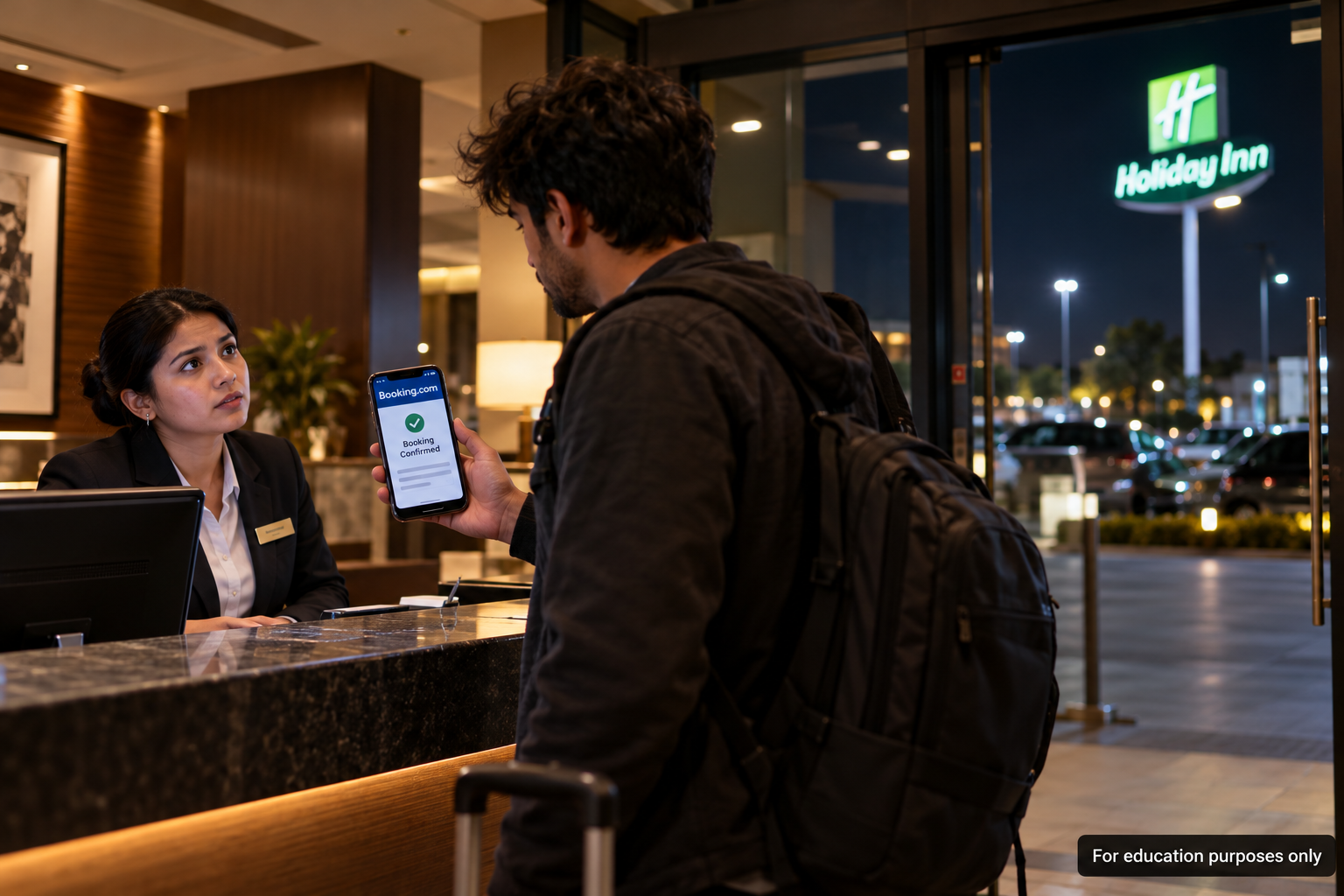
Here is a hotel that does not exist, though you have almost certainly slept in it.
It has about a hundred and forty rooms and sits beside a highway exit. The sign on the pole says Marriott, or Hilton, or Holiday Inn Express, and it makes no difference which. The woman at the front desk wears a name badge, but in this hotel the company that pays her is a management firm the owner hired, whose name appears nowhere in the building. The building belongs to the owner, a family partnership or a small fund with a mortgage to service and no habit of standing in that lobby on a Friday night. And the man at the counter, who has just given his name, did not find the hotel by driving past the pole. He found it on a phone, and the screen of that phone belongs to a fourth company that has never employed a single person in the building.
Four companies, a hundred and forty rooms, one tired guest waiting for a key. Ask who runs this hotel and you will get four answers, and each of them will be true. Which is why "the future of hotel management" starts to look slightly ill-posed once you stand in that lobby. Management of what? The building, the brand, or the guest?
The usual guess, when the future of hotels comes up, is robots. It is an easy picture to hold: a machine at the desk, a machine on the stairs, a hotel that runs itself. The most publicised test was Henn na, which opened in 2015 at a theme park in Nagasaki and made robot staff its whole identity. By early 2019 it had 243 robots and was planning to retire more than half of them. The reports at the time were unsentimental about why. The robots had failed to cut costs or workload. They broke down often enough that human staff worked overtime to repair them. The room robot mistook snoring for a command and woke the guest it was meant to serve, and the one at the front desk could not answer basic questions. Its parent company was reported to be planning eight more hotels in the same line, and one failure at one site proves less than it feels like it proves. But it does show where the dream was weakest, which was the exact moment a guest says something unexpected and someone has to answer.
The automation that actually reached hotels is quieter, and most of it involves no machine at all. It involves subtraction. In 2021 Hilton's chief executive told investors that housekeeping, food and beverage and other areas would come out of the pandemic as businesses that were "higher margin and require less labor than they did pre-Covid." CBRE's survey of American hotels, covering 2024, found the typical hotel in its sample working about seven percent fewer hours than in 2019 while paying twenty-two percent more in compensation. Offering guests points or a snack to skip daily room cleaning is not new, and brands have moved back and forth on the default since the pandemic. In July, a Marriott-brand hotel in Kraków was reported to be offering guests fifty Bonvoy points, worth thirty cents at best by one travel writer's reckoning, to skip it, with the hotel keeping the labour saving. No robot was involved. A loyalty currency was used to turn a cut into a choice.
Do guests mind? The largest dataset I found suggests not much, or not yet, though it was not built to answer that. J.D. Power's 2026 hotel guest satisfaction study, built on nearly forty-five thousand guest reports from May 2025 to May 2026, found overall satisfaction up thirteen points to 665 on a thousand-point scale, with all seven areas it scores improving, and its analyst credited courtesy from front desk staff and responsiveness to requests. A hotel-software vendor's survey found seventy percent of American travellers likely to use an app or kiosk, which sounds like the end of the desk until you notice the word likely. The same vendor's survey of hoteliers found fifty-nine percent wanting the welcome and check-in to stay human-led, and the ones saying so most often were the heaviest users of AI. The people who know the tool best seem least keen to point it at the one moment a guest looks up at a face.
That sounds like comfort, and there is a precedent that should make anyone wary of it. The standard story about bank tellers is that ATMs were supposed to destroy the job and the job survived instead. The economist James Bessen's version, in a 2015 article for the IMF's Finance & Development, is more careful than the slogan. ATMs cut the number of tellers needed to run an average urban branch from twenty to thirteen between 1988 and 2004, but they also "reduced the cost of operating a bank branch," so banks opened more of them (urban branches rose forty-three percent), and the tellers who stayed moved toward relationship work, where cash handling mattered less and human interaction more. So far, reassuring.
Now read what the US Bureau of Labor Statistics says today. It projects teller jobs to fall thirteen percent between 2025 and 2035, from about 339,000, and its explanation is a short list: fewer bank branches, more customers banking online, and automation, meaning video kiosks that let one teller serve more people and enhanced ATMs that now take over tasks like issuing debit cards. The machines are on that list, so I would not call them innocent. But the first two items are about where the customer goes, not about what the clerk does. The cash machine did not end the branch. The customer's first move went somewhere else, and the branch followed.
I kept coming back to that last sentence. What changed the bank was not mainly what happened to the task. It was where the customer started. If hotels follow the pattern, the interesting question is not what happens to the clerk's job but who the guest meets first, and who gets paid for it.
So start with what the sign on the pole actually sells. Marriott's latest annual report puts about two-thirds of its rooms, 66.5 percent, under franchise or licence agreements, nearly another third under management contracts, and under one percent in hotels it owns or leases. IHG's mix is starker: seventy-three percent franchised, twenty-seven percent managed, under one percent owned. These companies mostly do not run hotels. They license a promise and charge for it as a share of revenue. The HVS franchise fee guide, which covers ninety-three brands, puts the average total cost of a franchise between 9.6 percent of rooms revenue at the economy end and 12.9 percent at the top, and it is careful to say it measures costs, not benefits.
A fee on revenue is a particular kind of price. Think of a landlord who takes a slice of every sale instead of a fixed rent, and who also gets to say when the shop needs repainting. The shopkeeper can have a flood, a strike or a tax rise, and the landlord's cut still arrives, because it was levied on the till rather than on what was left. You can see the difference in IHG's accounts for 2025: its fee business earned about sixty-five cents of operating profit on each dollar of fee revenue, while the hotels it owns or leases earned under eight cents on each dollar of theirs. I would not push that comparison far, since a toll and a building are different kinds of business and the margins are not like for like. But it shows which seat the industry has spent years moving towards.
Now the other side of the ledger. CBRE's annual survey of 2,216 American hotels for 2025 found gross operating profit margins down from 35.1 to 34.8 percent and EBITDA margins down from 23.3 to 22.8. Operating profit grew 1.5 percent in dollars and EBITDA 0.3 percent, which, with prices rising, is a fall in real terms. Labour cost per occupied room rose 2.9 percent, and labour is more than half of operated departmental expenses. Insurance premiums fell 5.3 percent last year but still sit at double their 2019 level. In Los Angeles, hotels with sixty or more rooms must pay a cash wage of at least $25 an hour from this July, on top of a health benefit or its cash equivalent, rising to $30 in January 2030 after an amendment in May pushed back the $30 floor that had been promised for 2028. None of this is passed through the fee. The fee is a percentage of revenue, and revenue does not automatically rise when the wage floor does.
It is against that background that, on 20 March, fifty-one hotel owners put their names to a letter addressed to Marriott's chief executive, its chairman and its board. By their own count they owned 990 Marriott-branded hotels with about 182,000 rooms. The complaint, in one line, was that owners carry a growing share of the loyalty programme's costs while Marriott collects a growing share of its revenue. More than sixty percent of Bonvoy points, they said, are now earned through co-branded credit card spending rather than stays, so a growing share of redemptions may come from cardholders who are not regular hotel guests, reimbursed at rates the owners say do not reflect the cost. Marriott's card royalties were expected to approach a billion dollars this year, up about thirty-five percent. The letter drew little attention until the Wall Street Journal reported it in June. Marriott's second-quarter results then showed franchise and base management fees up fourteen percent to $1.37 billion, an increase the company described as "primarily driven by higher co-branded credit card fees", with rooms growth and higher revenue per room alongside. Trade reports say Marriott has made some concessions, including lower loyalty charge rates and higher reimbursements.
I want to be fair to the brands here, because the revolt story flatters my argument more than the evidence does. CBRE, looking at the same programmes, found that loyalty members made up 52.8 percent of occupied rooms in 2024 and that the programmes cost the average hotel $5.46 per occupied room, about 1.6 percent of revenue. It called them cost-effective "occupancy insurance," while advising owners to benchmark the return against other ways of getting guests. IHG says its members account for two-thirds of its room nights. So here are two measures that appear to disagree. On average, the programme is cheap and delivers more than half the guests. At the margin, the owners say, the next redemption costs more than it is reimbursed. An average and a marginal cost can both be right, and which one matters more depends on figures that, as far as I could find, are not public.
What bothered me about the revolt story was that owners as a class are not leaving. Marriott ended the second quarter with a pipeline of 4,186 properties and about 629,000 rooms, record signings for the first half, and conversions, existing hotels switching flags, making up over a third of those signings and forty percent of openings. The signatories are not the ones signing new deals, and walking away from a franchise agreement early typically costs money, so this is not a clean test. But if the brand were as poor a bargain as the letter implies, you would expect signings to thin, not set records.
The explanation, I think, is that a hotel without a brand does not escape the toll. It pays a different one. HOTREC's 2026 study of 2,713 European properties found that about half of bookings still come direct, but that the share going through online travel agencies had risen from about nineteen percent in 2013 to 29.9 percent in 2025, with Booking Holdings and Expedia handling more than eighty-five percent of it. Half the hoteliers said the platforms undercut their prices at least occasionally. CBRE's survey of 2024 results found commissions growing almost three times as fast as revenue per room. Without a loyalty programme behind it, a hotel has little to stop its guest coming back through the same door next time. Owners are not choosing between a landlord and freedom. They are choosing between landlords of the guest.
I wanted to know whether the platforms hold that guest because of a contract, because the paperwork said hotels could not undercut them. Europe offers something close to a natural comparison, because the paperwork came off in stages. Germany's competition authority went after the wide parity clauses from 2013. Booking and Expedia dropped them across Europe in 2015. France legislated against parity clauses of every kind that year. And on 2 December 2024, under the Digital Markets Act, Booking removed the clause from its European contracts altogether, leaving hotels free to undercut it on any channel. Over the same stretch, the online agencies' share went from about a fifth of bookings to nearly a third. It is tempting to read that as proof the clause was never the machinery, and that what holds the guest is visibility, who appears first when the traveller looks. But the data cannot carry that. The figures come from different surveys of different samples, the report I could read does not say how it defines "direct," and it is possible the share would have climbed even faster under the old clauses. All the comparison can say is that the thing the law removed does not seem to have been the thing that mattered most.
A landlord of the guest also writes the vocabulary the guest reads. In March 2024 Booking.com took its "Travel Sustainable" programme offline after the Dutch consumer authority, the ACM, concluded it could mislead: the name implied that staying at a participating property was sustainable, properties outside the programme looked as though they had done nothing, and some of the measures counted were already required by law. Booking later withdrew the badges worldwide. Since 27 September this year, EU rules ban generic claims such as "green" or "environmentally friendly" unless the trader can show recognised excellent environmental performance. I do not want to be cynical about this, because some of what hotels do for the environment is real and pays for itself. But energy is a small line. CBRE's estimates put utilities at roughly three to four percent of revenue at most hotels, growing more slowly than total operating expenses. The part of sustainability a guest sees is mostly a label, and labels belong to whoever controls the screen. The part that shows up in the accounts is mostly a utility bill. And the one gesture most guests actually meet, skipping the daily clean, is the same cut that saved the labour.
Which brings the argument to what everyone is waiting for. On 27 August, Google began a limited rollout of hotel booking inside its AI Mode in the United States, with launch partners that read like the cast of this essay: Booking.com, Expedia, Hilton, Marriott, IHG, Choice, Wyndham, Priceline, Hotels.com and Trip.com. Independent hotels were not on the launch list, and the coverage I read did not say how they would get on it. Google says the hotel remains the merchant of record and keeps the relationship and the booking data. It has not said what it will charge, and how loyalty points will be recognised in such a booking is, for now, an open question. The number that matters is small. Booking Holdings' finance chief said in August that bookings coming from conversational agents, free or paid, are under one percent of its room nights, with no significant recent change. The forecasts I came across, that AI agents will soon take a large slice of travel bookings, were forecasts, several from vendors with something to sell, not measurements.
There are only a few ways this goes, and I do not know which. The assistant could become one more online agency, taking a commission for putting a room in front of the traveller. It could become a toll for being legible to the machine at all. Or it could talk to hotels directly, in which case the hotel with the cleanest data and the most open door might win bookings from the platforms, and the landlord with the most to lose would be the one whose whole business is sitting in between. What decides it is a question that sounds philosophical and is actually commercial: whose agent is the agent? An assistant that works for the traveller has every reason to compare the hotel's own site with the platforms. One paid by whoever shows up first has no such reason. There is something uncomfortable about how much of the answer depends on the business model of whoever built it.
Which hotels are ready for that? A hotel-software vendor's survey of hoteliers found ninety-eight percent using AI, while HOTREC's survey found twenty-six percent of European hotels doing so, concentrated in chains and larger urban properties. They are not measuring the same hotels, and the gap between them is itself a clue to the answer.
Corporate travel is the cleanest place to watch all of this, because there the guest and the customer are not the same person. The traveller sleeps in the bed. The employer pays. A travel manager negotiates the rate, a booking tool decides what appears on the screen, and the hotel's own loyalty programme is quietly trying to persuade the traveller to book with the brand instead. Four claims on one person again. What is changing is the instrument of the negotiation. In a spring survey of 258 travel managers by GBTA and Radisson, forty-nine percent of programmes saw more dynamic discounts, meaning a percentage off whatever the live price is that day, against seventeen percent that saw more fixed negotiated rates. Thirty-two percent had used AI in their most recent hotel tender, and sixty-nine percent expected to next time. The annual handshake over a number is giving ground to a standing discount off the live price, although the survey still describes fixed rates as the foundation. GBTA's outlook, released on 3 August, expects global business travel spending to rise 7.2 percent this year to about $1.71 trillion but the number of trips by only 1.3 percent, and it puts the growth mostly down to higher prices. The business guest is recovering mostly in dollars, not in bodies.
The leisure guest looks different but rhymes. CoStar and Tourism Economics' August forecast notes that households earning $200,000 or more account for a quarter of travel spending while making up eleven percent of households. Colliers' first-half review found economy the only chain scale where occupancy, rate and revenue per room all fell, while luxury led growth, with revenue per room up 13.3 percent in June alone. People like to say hotels are heading for a barbell, luxury and budget thriving and the middle squeezed. The 2026 numbers look more like a slope, with luxury strongest and the squeeze at the bottom, though the August forecast credits some of this year's strength to the football World Cup, which will not be back next year. One of the best-known attempts to turn apartments into hotels at scale, Sonder, collapsed in November 2025, within days of Marriott ending the agreement that put it on Bonvoy. The causes were many, lease liabilities among them, and I would not hang a theory on one collapse. It is still worth noticing which door was shut.
Who sets the price while all this happens? The textbook picture is a revenue manager with a spreadsheet and a feel for the week. At some hotels at least, the more accurate answer is software supplied by a vendor, and a legal argument about whether that amounts to collusion. In 2025 the Ninth Circuit affirmed the dismissal of a claim against Las Vegas hotels that licensed the same pricing tool, Cendyn's Rainmaker, reasoning that recommendations nobody was bound to follow were not a restraint of trade, at least where competitors' confidential data was not alleged to be used. A review from a law firm that had represented one of the casino operators described the case law in January as running the defendants' way.
On 29 July the Third Circuit revived a similar claim over the same software in Atlantic City, where the plaintiffs allege the hotels fed non-public pricing and occupancy data into the system and then accepted its recommended rates about ninety percent of the time, which the court held was enough, at this early stage, to infer an agreement. Law-firm summaries stress that the ruling does not make sharing a vendor a violation in itself. But a body of law that looked settled in January was, by the end of July, not. So the price is set neither wholly at the property nor wholly by the machine, but in a space where a court can now ask who was following whose recommendation. The other end is policed too: under the Federal Trade Commission's rule, in force since 12 May 2025, a hotel's total price, mandatory fees included, has to be shown up front.
What is left, then, for the person who manages the building? The easy prediction is that the job dissolves into software and head office. The US Bureau of Labor Statistics projects something quite different: about 54,800 lodging managers in 2025, median pay of $69,250, employment growing four percent to 2035, and roughly 5,500 openings a year. The way in, it says, is "a high school diploma combined with several years of experience working in a lodging facility," or a degree in hospitality, which full-service hotels "may prefer." A degree is a preference, not a gate.
I went looking for the thing that would show the job hollowing out, an independent measure of how much pricing and selling authority has moved from the property to a regional office or a vendor, and I did not find one. What I found were vendors selling the centralised version, which is not the same as evidence. Think about what the job is if the guest, the price and the brand standards are all set elsewhere. It is the people and the cost. It is the part that a wage floor in Los Angeles makes dearer, that CBRE's hours-and-compensation numbers describe, and that no fee ever absorbs. My reading, and it is a reading rather than a finding, is that the general manager of the future may be as numerous as the one today but doing a different job: less the person who wins the guest, more the person who keeps the building solvent while someone else does.
India complicates the picture usefully, because here the building still seems to be most of the story. Nobody I could find has a trustworthy figure for how much of the country's hotel stock carries a brand. The president of the Hotel Association of India puts branded supply at about two lakh to 2.2 lakh rooms, and the only share I came across, a property portal's unsourced estimate of about eleven percent of all accommodation, I would treat as a hint rather than a number.
What can be measured is the direction. IHCL, which owns the Taj, reported its seventeenth consecutive record quarter for April to June, with revenue of ₹2,419 crore, management fee income up twenty-six percent, a portfolio of 645 hotels with 263 of them still in the pipeline, and fifteen hotels from the ANK Hotels and Pride Hospitality portfolios moved under its brands. Branded signings for the first half of 2026 were up eight percent to 28,268 keys while openings fell nine percent to 6,269, in a market where, according to a JLL executive, getting from approval to opening takes three to four years, against one to one and a half in parts of Southeast Asia, though he cites no source for it. Read together, they suggest a country where chains cannot build fast enough and so take in hotels that already exist, the same move Marriott describes globally. That is a reading, and the IHCL migration is one example, not a count.
The Competition Commission has already shown what the fight looks like when the guest is the prize. In October 2022 it found that an arrangement between MakeMyTrip-Goibibo and OYO had led to the delisting of FabHotels, Treebo and independent hotels, fined the two companies about ₹392 crore between them, and ordered MakeMyTrip-Goibibo to drop its price and availability parity obligations and its exclusivity conditions. OYO's penalty was stayed on appeal that November, and I could not confirm where the appeals ended. Whether the unbranded middle of Indian hospitality holds against the chains, or is absorbed one conversion at a time, is the question I most wanted to answer here and could not, because the two numbers that would help, how much of the stock is branded and how much of the booking runs through intermediaries, are not published anywhere I could find. If I had to bet, I would bet on slow absorption rather than a sudden squeeze, since converting a hotel is faster than building one. That is a bet.
I still do not know whose guest the man at the counter is. The brand would say he is a member. The booking site would say he is its customer. The assistant, if there was one, would say he asked it to choose. The owner would settle for a decent review and a bill that does not rise. Each of them is describing a real claim, and the argument between them is, I think, most of what the future of hotel management will turn out to be. But the study that measured how guests felt this year credited something smaller than any of those claims: courtesy at the front desk, and how quickly a request was answered. The only person in the lobby who is not in the argument is the one he will remember.
Notes: Room-mix and margin figures for Marriott and IHG come from their annual reports and Marriott's second-quarter 2026 release; the fee-business and owned-hotel margins are not like for like, so they illustrate structure rather than efficiency. Franchise fee ranges are HVS's as reported in the trade press, and vendor blogs that repeat them often confuse a share of revenue with a share of profit. Owner margins, hours, wages, commissions and loyalty costs come from CBRE surveys whose samples differ by year. The owners' letter and Marriott's concessions are described from the Wall Street Journal's report as relayed by Skift and Hotel Management, so the owners' counts are their own claim. European distribution figures are HOTREC's 2026 study via PhocusWire, and my reading that the parity clause was not the main mechanism is an inference. Google's AI Mode rollout was still described as limited, and forecasts of AI's share of bookings are forecasts, many from vendors. App, kiosk and AI-use percentages come from software vendors' own samples and measure stated attitudes. Henn na rests on 2019 reporting, the Hilton remark on 2021 reporting, the housekeeping history on Fortune in 2023 and the Kraków offer on a travel blog, so they illustrate rather than describe a norm. The pricing cases are described from law-firm summaries, one from a firm that represented a defendant, and the allegations are the plaintiffs'. The Los Angeles wage schedule was amended in May 2026 and may change again. Corporate and segment figures come from GBTA, Radisson, CoStar, Tourism Economics and Colliers via the trade press, and Sonder from Skift. Indian figures come from IHCL's results (whose release is inconsistent on whether the 645 hotels include the pipeline), HVS Anarock, and remarks by the Hotel Association of India's president and a JLL executive; the property-portal estimate is unsourced, and I could not verify how the Competition Commission case ended. Everything is current as of early October 2026 and indicates a pattern rather than precise constants, since hotel economics, platform terms and the law here are shifting quickly.